
Soundproofing Insulation in North Hollywood, CA
Expert Soundproofing Insulation in North Hollywood, CA — Storm-Tested, Warranty-Backed
Expert soundproofing insulation in North Hollywood, CA. Reduce aircraft, freeway & street noise. Free estimates. Call NoHo Insulation Pros at (818) 477-1218.
- Licensed & Insured
- Locally Owned & Operated
- Free Inspection & Estimate
Request Your
Free EstimateSoundproofing insulation is a specialized building solution that reduces the transmission of airborne noise and impact vibrations through walls, floors, ceilings, and attic spaces. Unlike standard thermal insulation, soundproofing insulation incorporates dense, acoustically engineered materials designed to absorb sound waves before they can travel between rooms or penetrate from exterior sources.
North Hollywood sits directly beneath some of the busiest flight corridors serving Hollywood Burbank Airport (BUR), and its grid of arterial streets — including Lankershim Boulevard, Cahuenga Boulevard, and Vineland Avenue — carries constant traffic noise into residential and commercial properties alike. The neighborhood’s rapid transformation into a creative and entertainment hub has also intensified noise concerns for both homeowners and studio-adjacent businesses.
At NoHo Insulation Pros, we understand the acoustic challenges unique to this corner of the San Fernando Valley. Our team delivers expert soundproofing insulation solutions tailored to North Hollywood’s specific building stock, climate, and noise environment. Call us today at (818) 477-1218 for a free consultation.
Understanding Soundproofing Insulation
Soundproofing insulation works by interrupting the path that sound waves travel through a structure. Sound moves in two primary forms: airborne sound (voices, music, traffic noise) and structure-borne sound (footsteps, mechanical vibrations, plumbing). Effective soundproofing insulation addresses both by adding mass, absorption, and decoupling to building assemblies.
The science behind acoustic insulation dates to mid-20th century construction research, when postwar suburban developments first began grappling with the noise pollution created by automobile culture and expanding air travel. California’s building code has since evolved — Title 24 of the California Code of Regulations now mandates minimum Sound Transmission Class (STC) ratings for residential construction near transportation corridors — but many of North Hollywood’s older homes were built well before these standards existed.
North Hollywood’s housing stock is particularly revealing of this history. The neighborhood saw its largest residential construction boom between 1940 and 1965, when thousands of single-family bungalows, dingbat apartment complexes, and mid-century ranch homes were built rapidly to house postwar workers at Lockheed, Republic Pictures, and NBC Studios. These structures typically used single-stud framing, minimal wall cavities, and fiberglass batts rated only for thermal performance — not acoustic performance.
Modern soundproofing insulation materials include mass-loaded vinyl (MLV), dense-pack cellulose, mineral wool (rockwool), open-cell and closed-cell spray foam, and acoustically engineered fiberglass batts. Each material has a distinct NRC (Noise Reduction Coefficient) and STC rating that determines its appropriateness for specific applications. Mineral wool, for example, achieves NRC ratings as high as 1.0 at certain frequencies, making it exceptionally effective for interior partition walls in recording studios and home theaters — both of which are common in the NoHo Arts District.
Soundproofing is not a single product but a system. True acoustic control requires the right insulation material combined with proper installation technique, air sealing, and sometimes structural decoupling. A wall cavity filled with the best mineral wool on the market will underperform if flanking paths — gaps around electrical outlets, unsealed penetrations, or uninsulated ceiling cavities — allow sound to bypass the insulation entirely. This is why professional installation matters so much in a dense urban environment like North Hollywood.
Why Soundproofing Insulation Is Needed in North Hollywood, CA
Airport Flight Corridors
Hollywood Burbank Airport (BUR) sits approximately 3.5 miles northeast of the NoHo Arts District. Aircraft on approach to Runway 8 and on departure from Runway 15 pass directly over North Hollywood neighborhoods including Lankershim, Toluca Woods, and Valley Village. The Federal Aviation Administration’s noise contour maps for BUR show that properties within the 65 DNL (Day-Night Average Sound Level) contour — which includes portions of North Hollywood east of Vineland Avenue — regularly experience exterior noise levels between 65 and 75 decibels during peak departure windows. Interior noise from low-flying aircraft can penetrate uninsulated attic spaces and reach 55–60 dB inside a bedroom, well above the EPA’s recommended 45 dB nighttime interior standard.
The 101 and 170 Freeway Interchange
The interchange of the Hollywood Freeway (US-101) and the Hollywood Freeway spur (CA-170) creates a persistent noise corridor that affects properties along Cahuenga Boulevard, Vineland Avenue, and the streets south of Magnolia Boulevard. CalTrans noise studies conducted during the 2018–2021 SR-170 interchange improvement project recorded exterior noise levels of 72–78 dB at residential property lines within 500 feet of the interchange. Without soundproofing insulation in exterior walls and attic assemblies, these levels translate to interior readings that disrupt sleep, concentration, and everyday communication.
Lankershim Boulevard Transit and Commercial Activity
The Metro B Line (Red Line) extension brought increased foot traffic and commercial development to the Lankershim Boulevard corridor after the North Hollywood station opened in 2000. Today, buses, delivery trucks, and rideshare vehicles operate around the clock along Lankershim, generating low-frequency noise that is particularly difficult to attenuate with lightweight insulation materials. Properties within two blocks of Lankershim between Magnolia and Chandler regularly measure exterior traffic noise at 68–74 dB during daytime hours.
Neighborhood-Level Noise Sources
Beyond major infrastructure, North Hollywood’s residential density creates its own noise challenges. The neighborhood’s dingbat apartment buildings — constructed predominantly between 1955 and 1968 — feature open-tuck parking below living units, thin concrete slabs, and essentially no acoustic separation between floors. Impact noise from upstairs neighbors is among the most common complaints we receive from residents in buildings along Cleon Avenue, Klump Avenue, and Radford Avenue in the North Hollywood core.
The Entertainment Industry Factor
North Hollywood’s identity as an entertainment and creative hub means that home recording studios, podcast production spaces, and rehearsal rooms are more common here than in almost any other residential neighborhood in the country. The NoHo Arts District, centered around the intersection of Lankershim and Magnolia, has attracted musicians, voice actors, and filmmakers who require genuine acoustic isolation — not just noise reduction — in their working and living spaces.
Signs You Need Soundproofing Insulation
Airborne Noise Intrusion
- You can clearly hear conversations from adjacent rooms or neighboring units without straining
- Television or music from a neighboring apartment is audible in your bedroom at normal volume levels
- Aircraft noise wakes you during early morning departure windows (typically 6:00–8:00 a.m. at BUR)
- Street traffic on Lankershim, Cahuenga, or Vineland is audible inside with windows closed
Impact Noise and Vibration
- Footsteps from upstairs neighbors are clearly audible and felt in the floor
- Plumbing vibrations travel audibly through walls and ceilings
- Closing doors in adjacent rooms causes perceptible vibration in your space
Structural Indicators
- Your home was built before 1978 and has never had insulation updated
- You can feel air movement around electrical outlets on exterior walls (indicates no wall insulation)
- Attic inspection reveals fiberglass batts with an R-value rating but no acoustic designation
Urgency Indicators
If interior noise levels are regularly disrupting sleep or preventing you from working from home — both increasingly common scenarios in post-pandemic North Hollywood — you should treat soundproofing insulation as an urgent priority rather than a deferred upgrade. Chronic sleep disruption from noise above 45 dB at night is associated with measurable cardiovascular health impacts according to World Health Organization guidelines.
Our Soundproofing Insulation Process
Acoustic Assessment and Noise Mapping (Day 1 — 2–3 Hours)
We begin with a thorough on-site acoustic assessment using calibrated sound level meters to identify your primary noise sources, measure interior noise levels in each affected room, and map flanking paths where sound bypasses existing assemblies. For North Hollywood properties near BUR flight paths, we time our measurements to capture both ambient and aircraft-event noise levels.
Building Envelope Review (Day 1 — 1–2 Hours)
Our technicians inspect your attic, wall cavities (using borescope cameras where non-invasive), crawl space, and mechanical penetrations. We evaluate existing insulation type, depth, and condition — particularly important in pre-1970 North Hollywood homes where original fiberglass batts may have settled, compressed, or become contaminated with rodent activity.
Custom Acoustic Plan and Material Specification (Day 1–2 — Provided in Writing)
Based on assessment findings, we prepare a written acoustic improvement plan specifying materials, target STC ratings for each assembly, and projected interior noise reduction in decibels. We explain every recommendation in plain language and provide itemized cost breakdowns before any work begins.
Insulation Removal (if Required) (Day 2–3 — 4–8 Hours)
If existing insulation must be removed — common in attics with rodent damage or in walls being opened for renovation — our team performs full removal and disposal using HEPA-filtered equipment. We follow California Department of Public Health guidelines for handling insulation materials in pre-1980 structures.
Air Sealing (Day 3–4 — 2–4 Hours)
Before installing acoustic insulation, we seal all penetrations, gaps around pipes, wiring, and recessed lights using acoustically rated sealants and expanding foam. This step alone can reduce sound transmission by 3–5 STC points and is frequently overlooked by non-specialist contractors.
Insulation Installation (Day 4–5 — 4–12 Hours Depending on Scope)
We install the specified acoustic insulation materials — mineral wool, dense-pack cellulose, spray foam, or a combination — using techniques appropriate to your building type. For North Hollywood’s dingbat apartments, this often includes decoupled ceiling assemblies with resilient channels to interrupt structure-borne impact noise.
Post-Installation Verification (Day 5–6 — 1–2 Hours)
We conduct post-installation sound level measurements and compare results against pre-installation baselines and target specifications. Results are documented and provided to you in a written completion report.
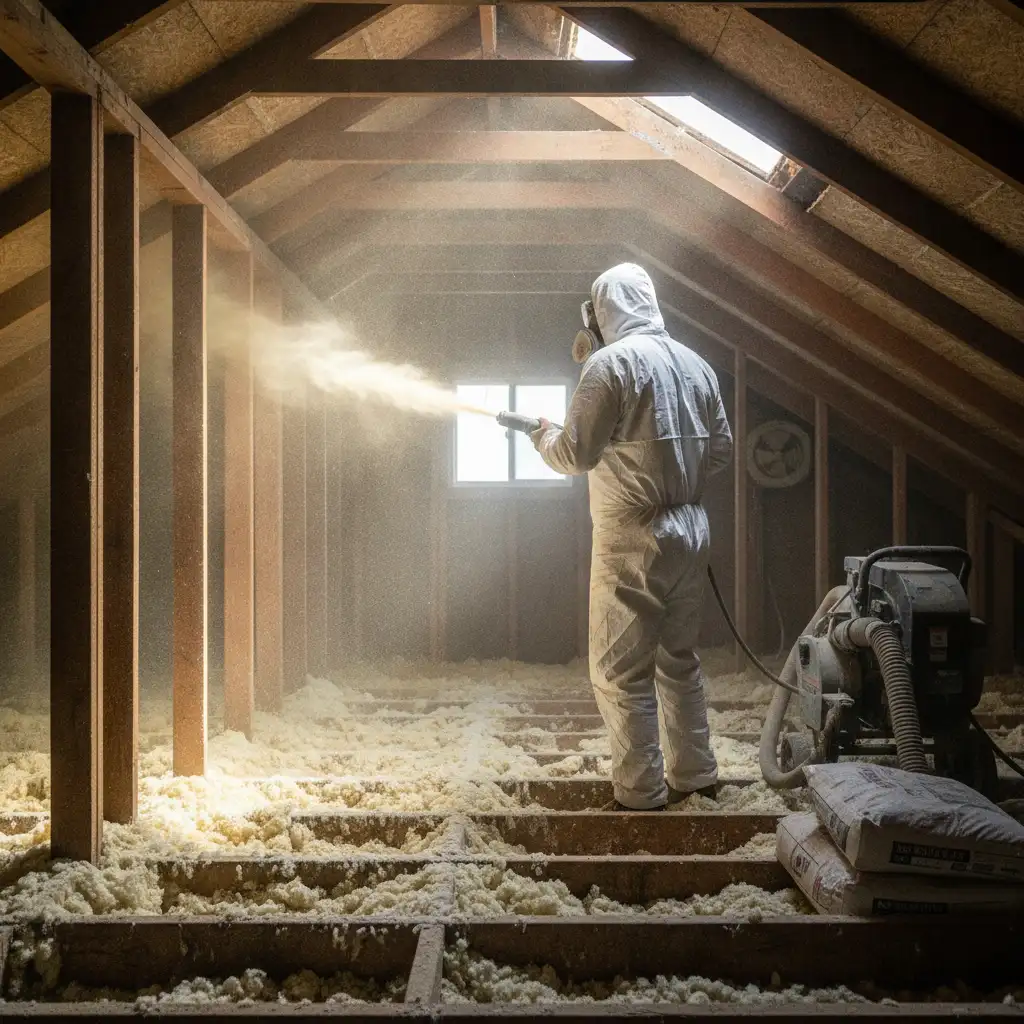
Our team in action — insulation professionals serving North Hollywood
Soundproofing Insulation Methods and Approaches
Mineral Wool (Rockwool) Insulation
Mineral wool is our most-recommended material for interior partition walls and ceiling assemblies in North Hollywood. With an NRC of up to 1.0 and STC contributions of 45–55 when properly installed, it excels in home recording studios, home theaters, and shared-wall residential applications in the NoHo Arts District. It is also fire-resistant and moisture-tolerant, making it suitable for North Hollywood’s occasional heavy rain events during El Niño years.
Dense-Pack Cellulose Insulation
Dense-pack cellulose — blown into existing wall cavities through small drill holes — is our preferred retrofit method for North Hollywood’s large stock of 1940s–1960s homes where opening walls is undesirable. At 3.5 lbs/ft³ installed density, it achieves meaningful mass and absorption without requiring demolition, typically improving wall STC ratings by 8–12 points over empty cavities.
Spray Foam Insulation
Open-cell spray foam is particularly effective for attic soundproofing in homes beneath BUR flight corridors. Applied to the underside of roof decking, it simultaneously addresses air leakage, thermal performance, and low-frequency aircraft noise attenuation. We also use closed-cell spray foam at crawl space perimeters and rim joists where moisture management is equally important.
Blow-In Fiberglass Insulation
For attic floor applications where budget is a primary concern, blow-in fiberglass provides a cost-effective acoustic improvement layer on top of existing thermal insulation. While not as acoustically dense as cellulose or mineral wool, increased R-value in the attic floor does contribute measurably to reducing airborne noise transmission from aircraft and rooftop HVAC units.
Mass-Loaded Vinyl (MLV) with Insulation Composite
For extreme noise environments — properties directly adjacent to the 101/170 interchange or within 1,000 feet of BUR approach paths — we incorporate mass-loaded vinyl barriers in combination with acoustic insulation for maximum STC performance in wall and ceiling assemblies.
Ready for Soundproofing Insulation? Get Your Free Estimate Today.
NoHo Insulation Pros serves North Hollywood and the surrounding area — we’ll be on-site within 24 hours.
📞 Call (818) 477-1218Soundproofing Insulation Cost in North Hollywood, CA
Soundproofing insulation costs in North Hollywood vary based on scope, material selection, and building type. Below are realistic price ranges based on current labor and material costs in the Los Angeles metro market.
Typical Cost Ranges
- Single-room wall insulation retrofit (dense-pack cellulose): $800–$1,800 per room
- Attic soundproofing with spray foam (open-cell, per 1,000 sq ft): $1,500–$3,500
- Full-home acoustic upgrade (walls, attic, crawl space): $6,500–$18,000 depending on home size and materials
- Crawl space encapsulation with acoustic insulation: $3,000–$7,500
- Recording studio or dedicated media room (single room, full system): $4,000–$12,000
- Insulation removal and replacement (attic only, per 1,000 sq ft): $1,200–$2,800
Factors That Affect Your Cost
- Building age: Pre-1965 North Hollywood homes often require more extensive air sealing and may have narrow wall cavities that limit material options
- Accessibility: Low-clearance attics (common in 1950s ranch homes) and crawl spaces with limited access increase labor time
- Existing insulation condition: Rodent-contaminated insulation in older North Hollywood properties requires professional removal before new material can be installed
- Material selection: Mineral wool costs approximately 15–25% more than fiberglass but delivers meaningfully higher acoustic performance
- Los Angeles labor market: Labor rates in the San Fernando Valley are higher than national averages, reflecting California licensing and wage requirements
We provide detailed written estimates at no charge. Call (818) 477-1218 to schedule yours.
Neighborhoods We Serve in North Hollywood
NoHo Arts District
The historic core around Lankershim and Magnolia features a mix of 1920s–1940s commercial buildings converted to live-work spaces and newer mixed-use developments. We frequently install acoustic insulation in shared-wall recording studios and podcast production suites throughout this area, where STC ratings of 55 or higher are often required.
Toluca Woods
This established residential neighborhood north of Magnolia features a concentration of 1950s–1960s ranch-style homes directly beneath BUR’s Runway 15 departure path. Attic soundproofing and exterior wall dense-pack retrofits are our most common projects here.
Valley Village
Bordering Studio City, Valley Village’s 1940s bungalows and postwar additions often have minimal wall cavity depth, making spray foam and dense-pack cellulose the preferred retrofit approaches. Impact noise between floors is a frequent concern in multi-unit properties here.
Lankershim Corridor
Properties within two to three blocks of Lankershim Boulevard face the most intense street-level and transit noise. We commonly install MLV-composite assemblies alongside mineral wool insulation for properties in this corridor.
Chandler Park Area
The residential streets surrounding Chandler Park contain a high concentration of 1960s dingbat apartments with thin concrete slab construction. Crawl space insulation and underfloor acoustic treatments are particularly valuable for ground-floor units in this area.
Soundproofing Insulation Maintenance Tips for North Hollywood Homeowners
- Inspect attic insulation annually: North Hollywood’s occasional heavy rain events (averaging 15 inches annually, with El Niño years exceeding 30 inches) can introduce moisture that compresses or damages acoustic insulation — check after any significant rainfall.
- Check for rodent activity every spring: The San Fernando Valley’s rodent pressure is significant; roof rats and squirrels commonly enter attics through gaps in the eave line and can shred insulation batts, dramatically reducing acoustic performance.
- Re-seal around new penetrations: Any time an electrician, plumber, or HVAC technician accesses wall or ceiling cavities, verify that penetrations are re-sealed with acoustically rated caulk.
- Monitor HVAC ductwork connections: Loose duct connections in attic spaces are a common flanking path for noise — inspect annually and re-seal with mastic as needed.
- Check crawl space vapor barrier integrity: North Hollywood’s clay-heavy soils retain moisture seasonally; a damaged vapor barrier can introduce humidity that degrades crawl space insulation over time.
- Address new noise sources promptly: If a new commercial tenant, HVAC unit, or construction project introduces a noise source near your property, have your acoustic insulation evaluated before the noise becomes a chronic problem.
- Schedule professional acoustic inspections every 5–7 years: Insulation settles and building envelopes shift — periodic professional review ensures your system continues to perform at its rated specifications.
Why Choose NoHo Insulation Pros
NoHo Insulation Pros is a locally based insulation contractor serving North Hollywood and the surrounding San Fernando Valley communities. We specialize in the specific acoustic challenges created by North Hollywood’s unique position beneath BUR flight corridors, adjacent to major freeway interchanges, and within a dense urban environment undergoing rapid commercial development.
Our technicians are trained in acoustic system design — not just insulation installation. We understand the difference between an R-value specification and an STC rating, and we communicate those differences clearly to every client. We work with North Hollywood’s diverse building stock, from 1930s bungalows near the NoHo Arts District to 1960s dingbat apartments on Cleon Avenue to newer mixed-use developments along Lankershim Boulevard.
We provide written acoustic assessments, material specifications, and post-installation verification measurements on every project. Our estimates are detailed, itemized, and provided at no charge. We use materials that meet California Title 24 energy and acoustic standards and carry all required California contractor licensing and insurance.
For expert soundproofing insulation in North Hollywood, call us at (818) 477-1218 or explore our related services: spray foam insulation, attic insulation, and crawl space encapsulation.
Frequently Asked Questions About Soundproofing Insulation in North Hollywood
How much does soundproofing insulation cost in North Hollywood?
Costs vary by scope and materials. A single-room retrofit using dense-pack cellulose typically runs $800–$1,800. A full-home acoustic upgrade addressing walls, attic, and crawl space ranges from $6,500 to $18,000 for a typical 1,500–2,000 sq ft North Hollywood home. Specialty applications like recording studios can range from $4,000 to $12,000 per room. We provide free itemized estimates — call (818) 477-1218 to schedule yours.
How much noise reduction can I realistically expect?
Results depend on your starting point and the scope of work. A dense-pack cellulose retrofit in empty wall cavities typically improves STC by 8–12 points, which corresponds to a perceived noise reduction of roughly 50%. Full acoustic system installations — including air sealing, decoupling, and mineral wool insulation — can achieve STC ratings of 50–60, reducing perceptible noise by 75% or more. We provide projected reduction estimates in decibels for every project based on pre-installation measurements.
Will soundproofing insulation help with aircraft noise from Burbank Airport?
Yes — particularly in the attic, which is the primary entry point for high-altitude airborne noise. Open-cell spray foam applied to the underside of roof decking, combined with air sealing of penetrations and HVAC boot connections, can meaningfully reduce interior aircraft noise levels. Properties in the Toluca Woods and Valley Village areas beneath BUR’s Runway 15 departure path frequently achieve 10–15 dB interior noise reductions after comprehensive attic acoustic treatment.
How long does soundproofing insulation installation take?
A single-room dense-pack retrofit can typically be completed in one day. Full-home projects — including assessment, air sealing, insulation removal (if needed), and installation — typically take 3–5 days for an average North Hollywood single-family home. We provide detailed project timelines in writing before work begins.
Do I need a permit for soundproofing insulation work in North Hollywood?
Most insulation retrofits that do not involve structural modifications or opening significant portions of finished wall or ceiling do not require a permit from the City of Los Angeles Department of Building and Safety. However, projects involving spray foam in enclosed attic spaces or any work affecting fire-rated assemblies may require inspection. We navigate permit requirements on your behalf and ensure all work meets applicable City of Los Angeles and California Title 24 standards.
Is soundproofing insulation the same as thermal insulation?
No — though there is overlap. Standard fiberglass batts are rated primarily for thermal performance (R-value) and provide only incidental acoustic benefit. True soundproofing insulation uses materials rated for both NRC (Noise Reduction Coefficient) and their contribution to STC (Sound Transmission Class) assemblies. Mineral wool and dense-pack cellulose provide meaningful acoustic performance that standard fiberglass does not. Many North Hollywood homes have thermal insulation that was never intended to address the neighborhood’s significant noise challenges.
Can you improve soundproofing in my apartment without major demolition?
In many cases, yes. Dense-pack cellulose can be injected into wall cavities through small drill holes that are patched after installation, avoiding large-scale drywall removal. Attic and crawl space treatments are also non-invasive. For ceiling impact noise in dingbat apartments — a very common issue in North Hollywood buildings on Cleon, Klump, and Radford — solutions typically require some ceiling work, but our team minimizes disruption and coordinates closely with property owners and tenants.
Does soundproofing insulation also improve energy efficiency?
Yes — particularly spray foam, dense-pack cellulose, and mineral wool, all of which provide meaningful R-value alongside acoustic performance. North Hollywood’s hot summers (regularly exceeding 100°F in the San Fernando Valley) mean that improved insulation delivers both acoustic comfort and reduced cooling costs. Many clients recoup a meaningful portion of their soundproofing investment through lower SoCalEdison bills within 3–5 years.
Get Your Free Soundproofing Insulation Quote in North Hollywood Today
If aircraft noise from Burbank Airport, freeway traffic from the 101 or 170, or street-level noise from Lankershim Boulevard is disrupting your sleep, work, or quality of life — NoHo Insulation Pros is ready to help. We serve homeowners, apartment residents, landlords, and creative professionals throughout North Hollywood with expert acoustic insulation solutions designed specifically for this neighborhood’s unique noise environment.
Our assessments are thorough, our estimates are free and itemized, and our installation teams are trained in acoustic system design — not just insulation. Don’t let North Hollywood’s noise define your indoor experience.
Call us now at (818) 477-1218 to schedule your free acoustic assessment and soundproofing insulation consultation. You can also learn more about our full range of services: insulation removal, blow-in insulation, and crawl space insulation.