
Rockwool Insulation in North Hollywood, CA
Energy-Saving Rockwool Insulation for North Hollywood, CA Homes — Licensed & Insured
NoHo Insulation Pros offers expert Rockwool insulation in North Hollywood, CA. Fire-resistant, soundproof, energy-efficient. Free estimates — call (818) 477-1218 today.
- Licensed & Insured
- Locally Owned & Operated
- Free Inspection & Estimate
Request Your
Free EstimateRockwool insulation — also known as mineral wool or stone wool — is a high-performance insulation material made from volcanic basalt rock and recycled slag. Spun into dense, fibrous batts or boards, it delivers exceptional thermal resistance, fire protection, and soundproofing that synthetic alternatives simply cannot match. For homeowners and business owners in North Hollywood, CA, this material is especially relevant given the region’s extreme summer heat, periodic Santa Ana wind events, and the wildfire exposure risk that comes with proximity to the Santa Monica Mountains and Verdugo Hills.
At NoHo Insulation Pros, we specialize in Rockwool insulation installation for residential and commercial properties throughout North Hollywood and the greater San Fernando Valley. Our team understands the unique building stock, climate pressures, and energy code requirements specific to this part of Los Angeles County. Whether you’re retrofitting a 1950s bungalow in Valley Village or insulating a newly constructed mixed-use building near the NoHo Arts District, we bring precision, local knowledge, and lasting results to every project. Call us today at (818) 477-1218.
Understanding Rockwool Insulation
Rockwool insulation has been manufactured commercially since the early 20th century, originating in Europe where volcanic stone was abundant and energy-efficient building was a cultural priority. The material is produced by melting basalt rock and industrial slag at temperatures exceeding 2,900°F, then spinning the molten material into fine fibers — a process not unlike how cotton candy is made, but at an industrial scale. The result is a dense, non-combustible product that resists temperatures up to 1,400°F, making it fundamentally different from fiberglass or cellulose alternatives.
In the United States, Rockwool gained widespread adoption beginning in the 1970s energy crisis, and its popularity surged again after the 2018 and 2019 California wildfire seasons brought fire-resistant building materials into sharp public focus. Today, it is available in several configurations:
- Batts and blankets — pre-cut panels sized for standard stud and joist spacing, ideal for walls, floors, and attics
- Loose-fill mineral wool — blown-in application for irregular cavities and existing wall retrofits
- Rigid mineral wool boards — used for continuous exterior insulation and commercial applications
- Mineral wool pipe insulation — applied around HVAC ducts and plumbing
Rockwool’s thermal performance is measured in R-value — a rating of resistance to heat flow. Standard 3.5-inch Rockwool batts achieve R-15, while 5.5-inch batts achieve R-23, outperforming comparably sized fiberglass products. For North Hollywood properties, this density matters because the San Fernando Valley experiences summer temperatures regularly exceeding 100°F, and an insulation product’s ability to slow radiant heat transfer directly correlates with energy savings on air conditioning bills.
Beyond thermal performance, Rockwool is naturally hydrophobic — it repels water rather than absorbing it — which is particularly valuable in crawl spaces and exterior wall assemblies where moisture intrusion is a recurring challenge. Its sound attenuation coefficient (NRC rating of approximately 1.0) also makes it the preferred choice for multi-unit residential buildings, home studios, and properties near busy commercial corridors like Lankershim Boulevard and Vineland Avenue.
Why Rockwool Insulation Is Needed in North Hollywood, CA
Extreme San Fernando Valley Heat
The San Fernando Valley operates in a classic inland basin climate. Surrounded by the Santa Monica Mountains to the south, the Verdugo Hills to the northeast, and the Simi Hills to the west, the valley traps heat with remarkable efficiency. North Hollywood’s average high temperature in July is approximately 98°F, and during heat events — such as the September 2022 heat dome that pushed local temperatures to 111°F at the Van Nuys Airport weather station — inadequately insulated attics can exceed 150°F internally. This heat radiates directly into living spaces, forcing air conditioning systems to work 40–60% harder than they would in a properly insulated building.
Santa Ana Wind Events and Fire Risk
Every fall and winter, dry, hot Santa Ana winds sweep through the San Fernando Pass and across North Hollywood, dramatically reducing relative humidity to single digits. These conditions, which historically coincide with major Southern California fire events including the 2008 Sayre Fire (which burned over 11,000 acres in nearby Sylmar) and the November 2018 Woolsey Fire, elevate the risk to residential properties. Rockwool’s non-combustible composition — it does not burn, melt, or emit toxic smoke — provides a meaningful layer of passive fire protection that fiberglass and foam board alternatives cannot offer. California’s 2020 updates to Title 24 energy standards also increasingly favor fire-resistant assemblies in wildland-urban interface (WUI) zones, which include portions of the North Hollywood Hills area.
Aging Building Stock with Degraded Original Insulation
A significant percentage of North Hollywood’s residential housing was constructed between 1945 and 1975 during the post-war San Fernando Valley suburban expansion. Many of these properties — particularly the single-family ranch homes in Lankershim Estates, the older bungalows near Magnolia Park, and the apartment complexes along Tujunga Avenue — were originally insulated with fiberglass batts rated R-11 or lower, or in some cases contain no wall insulation at all. After 50-plus years, this original insulation has compressed, settled, and in some cases been contaminated with mold or rodent activity, reducing effective R-values to near zero.
Multi-Unit Residential Sound Transmission
North Hollywood’s ongoing urban densification — evidenced by the Transit Oriented Communities (TOC) developments clustered around the North Hollywood Metro B Line station — is producing a large volume of new multi-unit residential construction. Tenants in these buildings, as well as in the existing dingbat-style apartment complexes throughout the neighborhood, consistently report sound transmission between units as a top quality-of-life concern. Rockwool’s Sound Transmission Class (STC) rating of 45–52 when installed in standard wall assemblies makes it the industry-leading choice for inter-unit noise control.
Crawl Space Moisture in Low-Lying Areas
Portions of North Hollywood situated near the Los Angeles River flood control channel — particularly neighborhoods south of Oxnard Street — experience seasonal ground moisture migration into subfloor crawl spaces. This moisture degrades traditional fiberglass batts within a few years, leading to sagging insulation, mold growth, and reduced thermal performance. Rockwool’s hydrophobic fiber structure resists this degradation, making it significantly more durable in these conditions.
Signs You Need Rockwool Insulation in North Hollywood
Energy and Comfort Warning Signs
- Monthly summer electricity bills exceeding $250–$350 for a standard 1,500–2,000 sq ft North Hollywood home
- Rooms that remain 8–10°F warmer than the thermostat setting despite continuous AC operation
- Noticeable hot spots along exterior walls or ceilings during afternoon hours
- HVAC system running nearly continuously during July and August heat waves
Structural and Material Warning Signs
- Visible fiberglass batts sagging or falling from crawl space floor joists
- Attic insulation compressed to less than 3–4 inches (indicating significant R-value loss)
- Discolored or stained insulation visible in attic access points, suggesting moisture or mold contamination
- Evidence of rodent nesting material woven into existing attic or crawl space insulation
Sound and Air Quality Warning Signs
- Clearly audible conversation, television, or footsteps from adjacent units or rooms
- Drafts felt near wall outlets, window frames, or recessed light fixtures
- Musty odors originating from under-floor areas, suggesting degraded crawl space insulation
Urgency indicator: If your North Hollywood property was built before 1978 and has not had a professional insulation inspection, schedule one before the next summer cooling season to avoid peak-season HVAC strain and maximum energy costs.
Our Rockwool Insulation Installation Process
NoHo Insulation Pros follows a structured, transparent process for every Rockwool insulation project in North Hollywood. Here is what you can expect from first contact to project completion.
On-Site Assessment (1–2 Hours)
Our technician visits the property and conducts a room-by-room thermal assessment. We inspect attic depth and existing insulation condition, crawl space moisture levels, wall cavity access points, and any current air sealing deficiencies. For North Hollywood properties near major corridors like Lankershim Boulevard or Vineland Avenue, we also assess exterior noise levels to determine whether acoustic-rated Rockwool assemblies are warranted.
Customized Project Proposal (24–48 Hours)
We generate a written proposal specifying Rockwool product type, target R-values by zone (attic, walls, floors), air sealing scope, and total project cost. All proposals reference California Title 24 minimum requirements applicable to your building type and year.
Insulation Removal (If Required) (Half-Day to Full Day)
For North Hollywood homes with degraded, contaminated, or rodent-damaged existing insulation, we perform complete insulation removal before installing new Rockwool material. This includes HEPA-vacuum extraction, sanitization of surfaces, and proper disposal in accordance with Los Angeles County waste management guidelines.
Air Sealing (2–4 Hours)
Before any Rockwool is installed, our team seals penetrations, top plates, recessed light housings, and attic bypasses using appropriate sealants and fire-rated foam products. This step is critical in older North Hollywood construction where decades of settling have created significant air infiltration pathways.
Rockwool Installation (4–8 Hours Depending on Scope)
Rockwool batts are friction-fitted into wall cavities, floor joists, and attic rafter bays. Unlike fiberglass, Rockwool holds its shape and does not require stapling or compression, which preserves full R-value. Our installers wear appropriate PPE and ensure all product edges are tightly butted to eliminate thermal bridging.
Quality Inspection and Thermal Verification (1 Hour)
After installation, our supervisor conducts a visual inspection and, when applicable, uses an infrared thermal camera to identify any gaps, compressions, or missed cavities. This step ensures your North Hollywood property meets or exceeds California Title 24 performance requirements.
Site Cleanup and Documentation (30–60 Minutes)
We remove all packaging material, restore attic access panels, and provide you with a written completion report including product specifications and installed R-values for permit records or future home sale documentation.
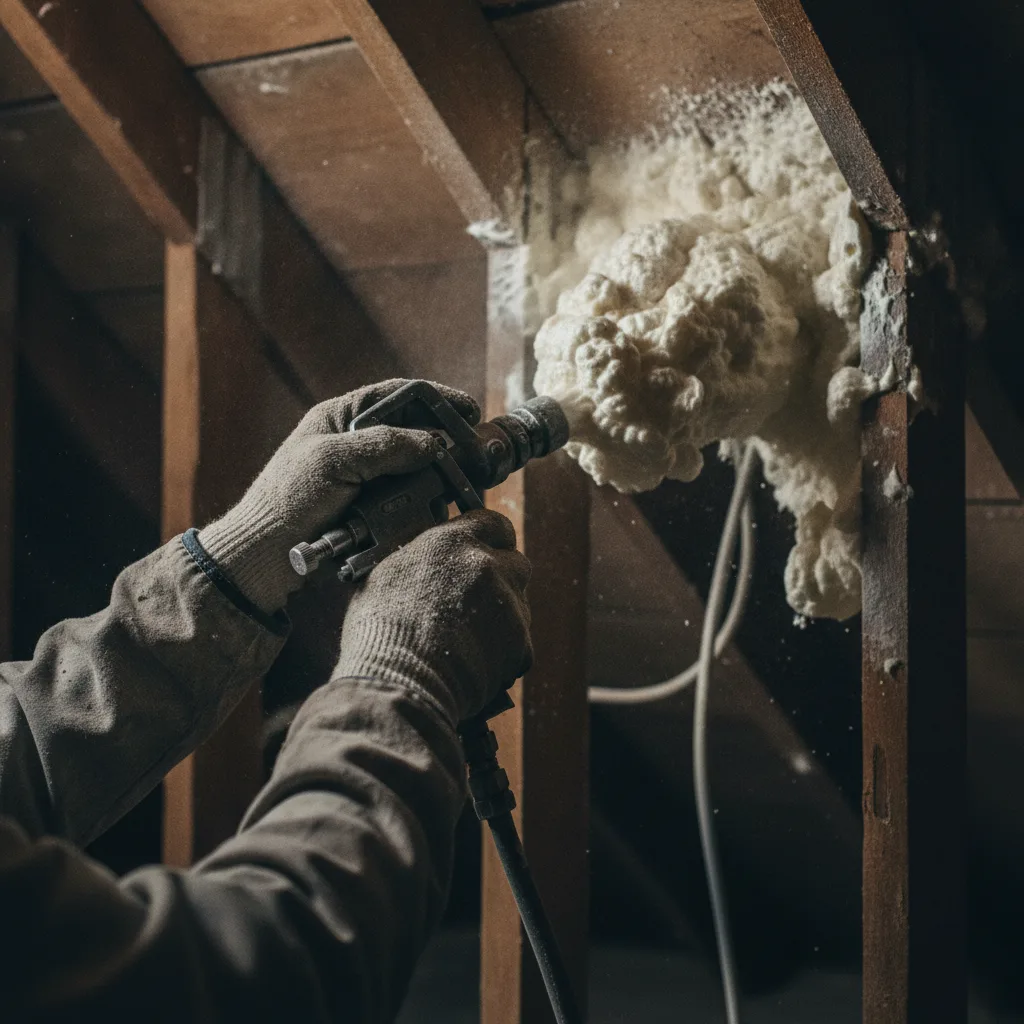
Our team in action — insulation professionals serving North Hollywood
Rockwool Insulation Methods and Approaches
Batt Installation (Walls and Attic Floors)
The most common method for new construction and open-cavity retrofits in North Hollywood. Rockwool Safe’n’Sound and COMFORTBATT products are cut to fit stud spacing (typically 16 or 24 inches on center) and pressed firmly into place. This method achieves R-15 to R-30 depending on cavity depth and is the standard approach for wood-framed residential construction built throughout the San Fernando Valley in the post-war era.
Continuous Rigid Board Installation (Exterior Walls)
Rockwool COMFORTBOARD 80 rigid mineral wool panels are installed on the exterior face of wall sheathing before cladding is applied. This method eliminates thermal bridging through studs — a significant heat loss pathway in North Hollywood’s older stick-frame homes — and is increasingly required for commercial projects under California’s updated energy codes. This approach is particularly effective on the south- and west-facing elevations of properties that receive maximum afternoon sun exposure.
Blow-In Mineral Wool (Enclosed Cavities)
For existing walls where opening the drywall is not practical, blow-in insulation using loose-fill mineral wool is injected through small holes drilled from the exterior or interior. This method is ideal for North Hollywood’s large inventory of 1950s and 1960s apartment buildings where wall cavities are empty but demolition is cost-prohibitive.
Rockwool Crawl Space and Floor Insulation
In homes with raised foundations — common in the older residential pockets near the North Hollywood Recreation Center and along Camarillo Street — Rockwool batts are installed between floor joists and secured with wire support or netting. The material’s moisture resistance makes it significantly more durable in North Hollywood’s seasonally damp crawl spaces than comparable fiberglass products. This is often paired with crawl space encapsulation for maximum performance.
Acoustic Wall Assemblies (Multi-Unit and Commercial)
For mixed-use and multi-family buildings near the NoHo Arts District, Rockwool Safe’n’Sound is installed in interior partition walls to achieve STC ratings of 45–52. This approach is combined with resilient channel mounting and acoustic caulk to meet or exceed Los Angeles building code requirements for sound isolation between dwelling units.
Ready for Rockwool Insulation? Get Your Free Estimate Today.
NoHo Insulation Pros serves North Hollywood and the surrounding area — we’ll be on-site within 24 hours.
📞 Call (818) 477-1218Rockwool Insulation Cost in North Hollywood, CA
Understanding typical pricing helps North Hollywood property owners plan budgets and evaluate proposals accurately. All figures below reflect current market conditions in the greater Los Angeles area.
Typical Cost Ranges
- Attic insulation (batt installation): $1.50–$3.00 per square foot, or $1,500–$4,500 for a typical 1,200–1,800 sq ft North Hollywood ranch home attic
- Wall insulation (open cavity, new construction or remodel): $1.75–$3.50 per square foot of wall area
- Blow-in wall insulation (existing closed cavities): $2.50–$5.00 per square foot
- Crawl space floor insulation: $2.00–$4.00 per square foot, typically $1,800–$5,500 for an average North Hollywood crawl space
- Rigid board continuous insulation (exterior commercial applications): $3.50–$6.00 per square foot installed
Factors That Affect Your Final Cost
- Existing insulation removal requirement (adds $0.50–$1.50 per sq ft)
- Attic accessibility — low-pitch rooflines common in 1950s North Hollywood homes can increase labor costs by 15–25%
- Presence of knob-and-tube wiring (requires electrical clearance before insulation installation)
- Air sealing scope and complexity
- Project size — larger square footages typically yield lower per-square-foot pricing
North Hollywood Pricing Notes
Los Angeles County labor rates run approximately 15–20% higher than national averages, which is reflected in local insulation pricing. However, California’s Energy Upgrade CA rebate programs and Southern California Edison’s residential energy efficiency incentives can offset 10–30% of qualifying project costs. Ask our team about current rebate availability when you call for your estimate at (818) 477-1218.
Neighborhoods We Serve in North Hollywood
NoHo Arts District
The dense, transit-oriented development corridor centered on Lankershim Boulevard features a mix of renovated commercial-to-residential conversions and newly constructed multi-family buildings. Sound attenuation is a priority here, and our acoustic Rockwool wall assemblies are in consistent demand for both new builds and tenant improvement projects.
Valley Village
This tree-lined residential enclave, bordered by Laurel Canyon Boulevard to the west and Coldwater Canyon to the east, contains a high concentration of post-war single-family homes built between 1948 and 1965. Most properties have original or degraded insulation and benefit significantly from full attic replacement and wall blow-in Rockwool upgrades.
Lankershim Estates
Older ranch-style homes in this neighborhood frequently have shallow attic cavities and raised foundations with unencapsulated crawl spaces. Our combined Rockwool floor insulation and crawl space insulation service is particularly effective for these property types.
Toluca Lake (North Hollywood Adjacent)
This affluent neighborhood’s larger custom homes along Cahuenga Boulevard often include home theaters, music rooms, and open floor plans that benefit from Rockwool’s superior soundproofing and thermal performance in premium interior assemblies.
Sun Valley (North Hollywood Transitional Zone)
Industrial and residential uses coexist here, and properties near the Hansen Dam Recreation Area often experience elevated ambient noise and seasonal moisture from the adjacent dam basin — making Rockwool’s dual thermal and acoustic performance particularly valuable.
Rockwool Insulation Maintenance Tips for North Hollywood Properties
- Inspect attic insulation annually — preferably in September before the fall Santa Ana wind season — for signs of displacement, pest activity, or moisture intrusion.
- Check crawl space insulation after winter rain events — particularly following above-average precipitation years like the 2022–2023 season, which brought over 22 inches of rain to the San Fernando Valley.
- Seal new attic penetrations promptly — any new recessed lighting, electrical work, or HVAC modifications that create gaps in the insulation plane should be re-sealed and re-insulated within 30 days.
- Monitor for rodent entry points — North Hollywood’s mature tree canopy creates roof-to-structure pathways for rats that can nest in and compress attic insulation. Address entry points at the roofline annually.
- Maintain adequate attic ventilation — Rockwool performs best when attic temperature differentials are managed through proper soffit and ridge vent airflow, especially during North Hollywood’s 100°F+ summer days.
- Do not compress or pack Rockwool batts — if storage items are placed in an insulated attic, ensure they rest on decking boards rather than directly on insulation, which reduces R-value through compression.
- Re-evaluate R-values after any remodel — wall or attic modifications during home renovation frequently displace or remove sections of Rockwool that should be restored to full depth before work is closed up.
Why Choose NoHo Insulation Pros for Rockwool Insulation in North Hollywood
NoHo Insulation Pros is a locally focused insulation contractor with deep familiarity with North Hollywood’s unique building types, climate challenges, and energy code requirements. We work with the full range of Rockwool product lines — from Safe’n’Sound acoustic batts to COMFORTBOARD rigid exterior panels — and we match the right product to each application rather than defaulting to a single solution for every project.
Our technicians are trained in California Title 24 compliance, and we stay current with Los Angeles County building permit requirements so your project is completed to code without costly re-inspections or corrections.
We serve the full spectrum of North Hollywood property types: 1950s ranch homes in Valley Village, mid-century apartment complexes near Tujunga Avenue, new mixed-use developments in the NoHo Arts District, and commercial buildings throughout the Van Nuys Boulevard corridor.
Beyond Rockwool, our team offers a complete range of insulation services including spray foam insulation, attic insulation, insulation removal and replacement, and crawl space encapsulation. Call us at (818) 477-1218 to schedule your free on-site assessment.
Frequently Asked Questions: Rockwool Insulation in North Hollywood, CA
How much does Rockwool insulation cost in North Hollywood, CA?
For a typical North Hollywood single-family home, Rockwool attic insulation installation ranges from $1,500 to $4,500 depending on attic square footage, accessibility, and whether existing insulation must be removed first. Wall insulation projects range from $1.75 to $5.00 per square foot of wall area depending on whether cavities are open (new construction or remodel) or closed (requiring blow-in application). Contact us at (818) 477-1218 for a free, itemized estimate.
Is Rockwool better than fiberglass for a North Hollywood home?
For most North Hollywood applications, yes. Rockwool outperforms fiberglass in three critical areas relevant to this region: fire resistance (non-combustible vs. fiberglass which melts at approximately 1,000°F), moisture resistance (hydrophobic vs. fiberglass which absorbs and retains moisture), and acoustic performance. Given North Hollywood’s wildfire exposure risk and its abundance of multi-unit residential buildings, these advantages are practically significant — not just theoretical.
How long does Rockwool insulation last?
Rockwool insulation is rated for the lifetime of the building when properly installed and protected from physical damage. Unlike fiberglass, it does not settle, compress over time, or degrade when exposed to moderate moisture — which is particularly relevant for crawl space and exterior wall applications in North Hollywood’s variable climate.
Do I need a permit for Rockwool insulation installation in North Hollywood?
In most cases, adding insulation to an existing residential attic or crawl space does not require a permit under Los Angeles City Building and Safety guidelines. However, wall insulation that involves opening and closing drywall, or any work associated with a broader remodel, may require a permit. Our team will advise you on permit requirements specific to your project during the assessment phase.
Can Rockwool insulation help reduce my Southern California Edison electricity bill?
Yes, significantly. Properly insulated attics in North Hollywood homes typically reduce cooling-season energy consumption by 20–40%. Given that air conditioning accounts for 40–60% of a summer electricity bill in the San Fernando Valley, this translates to meaningful annual savings — often enough to recover the installation cost within 4–7 years. SCE also offers Energy Efficiency rebates for qualifying insulation upgrades.
How long does Rockwool insulation installation take in a typical North Hollywood home?
A standard attic insulation project (following any required removal) typically takes one full working day — 6 to 8 hours — for a 1,200–1,800 sq ft home. Combined attic and crawl space projects may span two days. Wall blow-in projects for a full-size home typically require 1–2 days depending on the number of wall cavities and exterior access conditions.
Is Rockwool insulation safe for my family?
Yes. Rockwool is GREENGUARD Gold certified, meaning it meets rigorous standards for low chemical emissions in indoor environments. It does not contain formaldehyde, asbestos, or the glass fibers associated with older fiberglass products. Once installed and enclosed, there is no ongoing health risk. During installation, our technicians wear appropriate respiratory protection and we advise occupants to vacate the work area while batts are being cut and fitted.
Do you also remove old insulation before installing Rockwool?
Yes. Our team provides complete insulation removal services using commercial-grade HEPA vacuum equipment before installing new Rockwool material. This is particularly important for North Hollywood properties with rodent-contaminated or mold-affected existing insulation, where installing new material over compromised old insulation would reduce effectiveness and create ongoing air quality concerns.
Get a Free Rockwool Insulation Estimate in North Hollywood Today
If your North Hollywood home or commercial property is dealing with high summer energy bills, uncomfortable rooms, poor sound control between units, or degraded crawl space insulation, Rockwool is very likely the right solution — and NoHo Insulation Pros is the right team to install it.
We offer free, no-obligation on-site assessments for all North Hollywood properties. Our technician will evaluate your current insulation conditions, explain your options in plain language, and provide a written estimate with itemized pricing. There is no pressure and no commitment required.
Call us now at (818) 477-1218 to schedule your assessment. We serve North Hollywood, Valley Village, Toluca Lake, Sun Valley, and surrounding San Fernando Valley communities.
Don’t face another North Hollywood summer without proper insulation — contact NoHo Insulation Pros today and start saving on your next energy bill.