
Blown-In Attic Insulation in North Hollywood, CA
Energy-Saving Blown-In Attic Insulation for North Hollywood, CA Homes — Licensed & Insured
Get expert blown-in attic insulation in North Hollywood, CA. NoHo Insulation Pros upgrades your attic to R-49+, cuts LADWP bills & offers free assessments. Call (818) 477-1218.
- Licensed & Insured
- Locally Owned & Operated
- Free Inspection & Estimate
Request Your
Free EstimateBlown-in attic insulation is a high-performance insulation method that uses a specialized blowing machine to distribute loose-fill insulating material — typically cellulose or fiberglass — evenly across your attic floor, filling gaps, voids, and hard-to-reach corners that traditional batt insulation simply cannot cover. The result is a seamless thermal envelope that dramatically reduces heat transfer between your living space and your attic.
In North Hollywood, where summer temperatures routinely climb into the triple digits and aging mid-century housing stock dominates the residential landscape, properly installed blown-in insulation is not a luxury — it is a necessity. The San Fernando Valley’s intense solar exposure, combined with urban heat island effects concentrated along corridors like Lankershim Boulevard and Cahuenga Pass, makes attic heat gain one of the leading drivers of residential energy waste in the area.
NoHo Insulation Pros specializes in blown-in attic insulation solutions tailored specifically to the construction styles, climate demands, and building codes of North Hollywood and the greater San Fernando Valley. Call us today at (818) 477-1218 to schedule your free attic assessment.
Understanding Blown-In Attic Insulation
Blown-in attic insulation — also referred to as loose-fill insulation — has been in widespread use across the United States since the mid-20th century. The technology gained significant traction during the energy crises of the 1970s when federal and state agencies began incentivizing homeowners to reduce residential energy consumption. California, always at the forefront of energy efficiency legislation, adopted some of the most aggressive insulation standards in the country, which are codified today in Title 24 of the California Code of Regulations.
The process works by feeding raw insulating material into a pneumatic blowing machine, which uses pressurized air to propel the material through a long flexible hose into the attic space. A trained technician directs the hose to ensure even coverage across the entire attic floor, building up depth incrementally until the desired R-value — a measurement of thermal resistance — is achieved. For North Hollywood homes, the current California Energy Commission recommendation for Climate Zone 9, which encompasses most of the San Fernando Valley, is a minimum of R-38, though upgrading to R-49 or even R-60 is increasingly common and cost-effective given local energy rates.
Two primary materials are used in blown-in applications:
- Cellulose: Made from approximately 80% recycled paper fiber treated with borate compounds for fire and pest resistance, cellulose is a dense, eco-friendly option with strong air-sealing characteristics. It performs exceptionally well in the enclosed attic spaces typical of North Hollywood’s ranch-style homes and post-war bungalows.
- Fiberglass: Composed of spun glass fibers, blown fiberglass is lighter than cellulose, resists moisture absorption, and does not settle as significantly over time. It is a preferred choice for homes with vaulted or cathedral ceilings or attics with limited access points.
North Hollywood’s residential housing stock is heavily weighted toward construction eras from the 1940s through the 1970s — periods when insulation requirements were minimal or nonexistent. A 1955 ranch home in Valley Village or a 1963 stucco duplex near Lankershim Arts District may have original insulation that has degraded to a fraction of its original R-value or, in many cases, no insulation at all. Blown-in installation is the most practical and non-invasive solution for upgrading these properties without major structural modification.
Why Blown-In Attic Insulation Is Needed in North Hollywood, CA
Extreme Heat in the San Fernando Valley
The San Fernando Valley is one of the hottest urban environments in Southern California. North Hollywood regularly records summer high temperatures between 95°F and 108°F, with extreme heat events occasionally pushing temperatures past 110°F. During the September 2022 heat dome — one of the most severe on record for the region — temperatures in the eastern San Fernando Valley reached 111°F over consecutive days. Without adequate attic insulation, attic temperatures in these conditions can exceed 160°F, which radiates heat directly into living spaces below and forces air conditioning systems to work continuously, sometimes to the point of failure.
California’s Climate Zone 9, which includes North Hollywood, is characterized by hot, dry summers and mild winters with occasional cold spells. This climate demands insulation that performs in both directions: blocking heat gain in summer and retaining interior warmth during winter nights, which can dip into the 40s°F in December and January.
Urban Heat Island Effect Along Key Corridors
North Hollywood’s dense commercial corridors — particularly along Lankershim Boulevard, Tujunga Avenue, and the Cahuenga Pass — generate substantial urban heat island effects. Dark asphalt surfaces, reduced tree canopy in older industrial blocks, and concentrated vehicle traffic raise ambient temperatures in these neighborhoods 5°F to 8°F above surrounding suburban areas. Homes within a half-mile of these corridors experience measurably higher cooling loads, making high-performance attic insulation even more critical.
Aging Housing Stock with Inadequate Original Insulation
The majority of North Hollywood’s single-family homes were built between 1940 and 1975. During this period, Title 24 did not yet exist, and insulation was not required by California building codes. Many homes were built with either no attic insulation or minimal fiberglass batts with R-values as low as R-7 or R-11. Even homes that received insulation upgrades in the 1980s or 1990s may now have materials that have settled, compressed, or become contaminated with dust, moisture, or rodent activity — all of which significantly degrade thermal performance.
LADWP Energy Costs and Rate Structures
North Hollywood residents are served by the Los Angeles Department of Water and Power (LADWP). LADWP’s tiered rate structure means that households exceeding baseline energy allocations — common in summer months with heavy air conditioning use — pay significantly higher per-kilowatt-hour rates on the upper tiers. Upgrading attic insulation to R-49 or above can reduce cooling energy consumption by 20% to 40%, translating directly into lower monthly bills and reduced exposure to upper-tier rate penalties.
Wildfire Smoke and Air Quality Events
The North Hollywood area is periodically affected by smoke events from regional wildfires, including the 2019 Getty Fire and the 2018 Woolsey Fire, both of which blanketed the San Fernando Valley in heavy smoke. Properly sealed blown-in insulation combined with air-sealing measures helps reduce particulate infiltration into attic spaces, protecting HVAC equipment and improving overall indoor air quality during these events.
Signs You Need Blown-In Attic Insulation
Energy and Comfort Warning Signs
- Monthly LADWP electricity bills exceeding $250–$350 during summer months in a standard single-family home
- Rooms on the top floor or directly below the attic consistently 8°F–15°F warmer than the rest of the home
- Air conditioning running continuously during afternoon hours even when set to 75°F or lower
- Cold drafts or uneven temperatures throughout the home during winter months
Physical Inspection Indicators
- Visible attic floor joists with little to no insulation material covering them
- Existing insulation depth of less than 10 inches (indicating R-values likely below R-30)
- Insulation that appears yellowed, compressed, dusty, or contaminated with rodent droppings
- Water stains on existing insulation indicating past or ongoing roof leaks
Structural and Age-Related Indicators
- Home built before 1978 with no documented insulation upgrade history
- Recent roof replacement with no accompanying attic insulation inspection
- Evidence of pest activity — rodents, squirrels, or insects — that may have disturbed or contaminated existing insulation
Urgency Note: If your home is approaching summer without adequate attic insulation, the window for comfortable, affordable installation narrows quickly. Schedule an assessment before peak season pricing and scheduling constraints take effect.
Our Blown-In Attic Insulation Process
Free Attic Assessment and Energy Audit (1–2 Hours)
Our technician accesses your attic to measure existing insulation depth, assess material condition, identify air leaks, inspect for moisture damage, and evaluate attic ventilation. We document current R-values and provide a written assessment with specific upgrade recommendations calibrated to California Climate Zone 9 standards.
Air Sealing and Prep Work (2–4 Hours)
Before any insulation is blown in, we seal all attic bypasses — gaps around plumbing penetrations, electrical boxes, recessed lighting fixtures, HVAC ducts, and partition top plates. In North Hollywood’s older homes, these bypasses are often significant sources of conditioned air loss. We use fire-rated caulk and expanding foam appropriate for California’s seismic and fire code requirements.
Existing Insulation Removal (if Required) (2–6 Hours)
If existing insulation is contaminated, moisture-damaged, or harboring pest debris, we perform professional insulation removal using HEPA-filtered vacuum equipment before installing new material. This step is especially common in pre-1970s North Hollywood homes where original fiberglass batts have accumulated decades of dust and pest activity.
Ventilation Baffle Installation (1–2 Hours)
To maintain proper soffit-to-ridge airflow — critical in North Hollywood’s hot climate for attic temperature management — we install ventilation baffles along all eave areas before blowing insulation. This prevents insulation from blocking soffit vents and ensures the attic’s passive ventilation system continues to function correctly.
Blown-In Installation (2–4 Hours)
Using calibrated commercial blowing machines, our technicians install cellulose or fiberglass insulation to a precisely measured depth. We use depth markers placed throughout the attic to verify consistent coverage. For most North Hollywood homes, we install to a minimum depth of 15–16 inches of cellulose or 17–19 inches of fiberglass to achieve R-49.
Final Inspection and Documentation (30–60 Minutes)
We photograph the completed installation, document R-values achieved, and provide a written completion certificate. This documentation is often required for LADWP energy efficiency rebate applications.
Rebate Assistance
We assist customers with LADWP residential energy efficiency rebate paperwork, which can offset a portion of installation costs for qualifying upgrades.
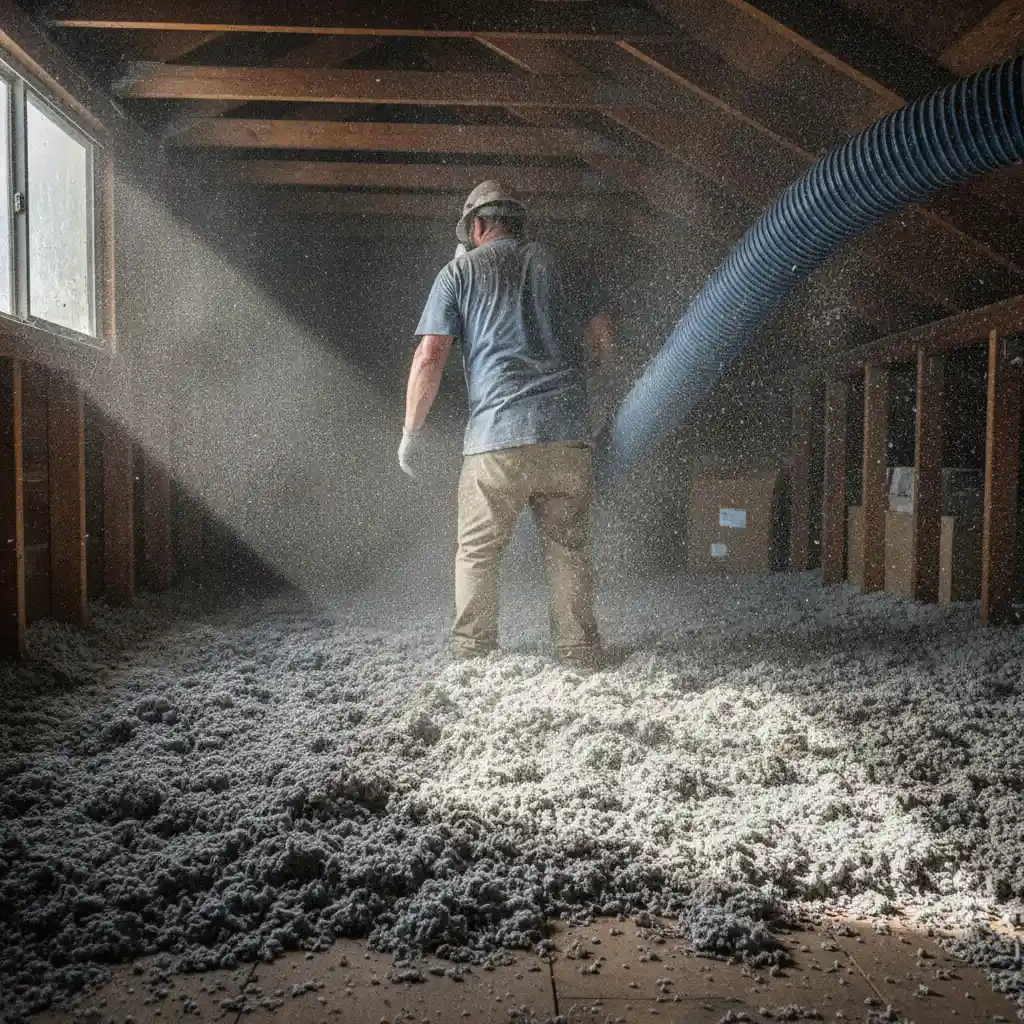
Our team in action — insulation professionals serving North Hollywood
Blown-In Insulation Methods and Approaches
Blown Cellulose (Loose-Fill)
Our most frequently specified material for North Hollywood’s ranch-style and bungalow homes. Cellulose’s dense packing characteristics make it effective at filling irregular spaces and providing superior air resistance. Its recycled content aligns with California’s sustainability priorities, and its fire-retardant borate treatment provides additional protection relevant in a region with significant wildfire risk. Best used in open, accessible attic spaces where full depth coverage can be achieved.
Blown Fiberglass (Loose-Fill)
Preferred for homes with limited attic access, cathedral ceilings, or areas where moisture exposure is a concern. Blown fiberglass does not absorb water and maintains its R-value in humid conditions — relevant during North Hollywood’s occasional late-summer monsoon moisture events. It is also the appropriate choice when blowing over existing intact fiberglass batts that do not require removal.
Dense-Pack Cellulose
Used specifically for closed cavities such as wall assemblies, knee walls, and cathedral ceiling rafter bays. Installed at 3–3.5 lbs per cubic foot, dense-pack cellulose resists settling and provides meaningful air-sealing within enclosed spaces. This method is particularly valuable in North Hollywood’s multi-story apartment buildings and older craftsman-style homes with complex roof lines.
Hybrid Approach (Spray Foam + Blown-In)
For maximum performance, we sometimes recommend a hybrid system: a flash coat of spray foam insulation applied to the attic floor to seal all penetrations and provide a vapor-resistant layer, followed by blown-in cellulose or fiberglass on top to achieve the required R-value. This approach delivers both superior air sealing and high thermal resistance and is ideal for LADWP’s highest rebate tier projects.
Ready for Blown-In Attic Insulation? Get Your Free Estimate Today.
NoHo Insulation Pros serves North Hollywood and the surrounding area — we’ll be on-site within 24 hours.
📞 Call (818) 477-1218Blown-In Attic Insulation Cost in North Hollywood, CA
Understanding the cost of blown-in attic insulation helps homeowners plan effectively and evaluate quotes accurately. The following ranges reflect current market conditions in North Hollywood and the San Fernando Valley.
Typical Cost Ranges
- Basic blown-in installation (R-30 to R-38) for 1,000–1,500 sq ft attic: $900–$1,600
- Full upgrade to R-49 for 1,000–1,500 sq ft attic: $1,400–$2,200
- Full upgrade to R-60 for 1,000–1,500 sq ft attic: $1,800–$2,800
- Insulation removal prior to new installation (per 1,000 sq ft): $500–$1,200 additional
- Air sealing package (included in our standard quotes): $200–$600 value
Key Cost Factors in North Hollywood
- Attic access difficulty: Many 1950s–1960s North Hollywood homes have low-pitch roofs with limited clearance, requiring more labor time.
- Existing material condition: Contaminated insulation requiring professional removal adds to total project cost.
- Material choice: Cellulose is typically 10–15% less expensive than fiberglass at equivalent R-values.
- Attic square footage: Larger attics benefit from economies of scale in per-square-foot pricing.
Available Rebates and Incentives
LADWP currently offers residential insulation rebates of up to $0.10–$0.15 per square foot for qualifying upgrades meeting Title 24 standards. Federal tax credits under the Inflation Reduction Act (IRA) allow homeowners to claim 30% of insulation project costs, up to $1,200 annually. These incentives can meaningfully reduce net out-of-pocket costs. Call us at (818) 477-1218 for a detailed cost estimate specific to your home.
North Hollywood Neighborhoods We Serve
Valley Village
A predominantly residential neighborhood featuring a high concentration of 1940s–1950s traditional and ranch-style homes. Valley Village properties frequently have original knob-and-tube electrical work and uninsulated attic spaces — conditions that require careful air-sealing before blown-in installation. Attic insulation upgrades here routinely involve removal of deteriorated original batts.
NoHo Arts District
The dense residential streets surrounding the NoHo Arts District contain a mix of pre-war bungalows, 1960s apartment buildings, and newer infill construction. Older multi-unit buildings in this area often have shared attic spaces with complex framing that benefits from blown-in coverage over batt installation.
Toluca Lake
Toluca Lake’s larger, higher-value homes — many dating from the 1930s and 1940s — present unique insulation challenges including complex rooflines, multiple attic zones, and historically significant architectural features that must be preserved during installation. Our technicians are experienced with the precise work these properties require.
Lankershim / AMDA Area
The residential streets adjacent to Lankershim Boulevard face amplified urban heat island effects and noise from commercial traffic. Homes here benefit particularly from dense-pack cellulose for its combined thermal and acoustic dampening properties.
North Hollywood Industrial Transition Zone
Residential properties near the Oxnard Street corridor and the former industrial areas south of Burbank Boulevard include a mix of older worker housing and newer townhome developments. Crawl space insulation combined with attic blown-in upgrades is a common combined service request in this area.
Blown-In Attic Insulation Maintenance Tips for North Hollywood Homeowners
- Inspect annually: Conduct a visual attic inspection each fall before winter rains begin. Look for signs of moisture, pest activity, or displaced insulation around HVAC equipment access areas.
- Check attic ventilation: North Hollywood’s hot summers stress attic ventilation systems. Verify soffit vents are not blocked by blown-in material and that ridge vents remain clear of debris after Santa Ana wind events.
- Monitor for pest intrusion: Squirrels, roof rats, and birds are active in the San Fernando Valley year-round. Seal any gaps in fascia or soffit boards before they allow animals access to your attic and insulation.
- Inspect after significant weather events: Following heavy El Niño-driven rainfall seasons, check for any roof leaks that may have saturated blown-in material, which can cause settling and mold growth.
- Keep attic access sealed: Ensure your attic access hatch has a fitted, insulated cover. Uninsulated hatches are one of the most common sources of conditioned air loss in North Hollywood homes.
- Do not compress or walk on insulation: Blown-in insulation loses R-value when compressed. Use attic walkboards for any equipment access rather than stepping directly on insulation.
- Recheck depth every 10 years: Cellulose can settle 10–15% over time. A decade after installation, verify depth with a ruler and top off if measurements have dropped below target levels.
Why Choose NoHo Insulation Pros
NoHo Insulation Pros is a North Hollywood-based insulation company serving homeowners and property managers throughout the eastern San Fernando Valley. Our technicians live and work in this community — we understand the specific construction patterns of Valley Village bungalows, the heat challenges of Lankershim corridor properties, and the rebate programs available through LADWP that can offset your investment.
We offer a comprehensive range of insulation services under one roof, including insulation installation, spray foam insulation, blow-in insulation, crawl space encapsulation, crawl space insulation, insulation removal, and insulation replacement — meaning you work with a single trusted contractor regardless of the scope of your project.
Every project begins with a free, no-pressure attic assessment. We provide written quotes with itemized material and labor costs, clear timelines, and transparent documentation suitable for LADWP rebate applications and IRA tax credit filings. Our work is performed by trained, full-time technicians — not seasonal subcontractors — ensuring consistent quality on every job.
Call (818) 477-1218 to speak directly with our team.
Frequently Asked Questions About Blown-In Attic Insulation in North Hollywood
How much does blown-in attic insulation cost in North Hollywood?
For a typical 1,000–1,500 square foot attic in North Hollywood, blown-in insulation installation to California’s recommended R-49 level costs between $1,400 and $2,200. Factors that affect pricing include attic size, access difficulty, whether old insulation needs to be removed, and material choice (cellulose vs. fiberglass). LADWP rebates and federal tax credits can reduce net costs by $300–$700 or more.
How long does blown-in attic insulation installation take?
Most residential projects in North Hollywood are completed in a single day — typically 4 to 8 hours depending on attic size, access conditions, and whether insulation removal is required. We schedule morning start times to complete work before peak afternoon heat, which improves both working conditions and installation quality.
Is blown-in insulation better than batts for North Hollywood homes?
For most North Hollywood homes — especially pre-1980 construction — blown-in insulation is superior to batt insulation because it fills irregular spaces, covers existing framing and obstructions completely, and provides better air resistance. Batt insulation requires perfect framing geometry to perform as rated; blown-in achieves consistent R-values regardless of the framing variations common in older San Fernando Valley construction.
Will blown-in insulation reduce my LADWP bill?
Yes, significantly. Homeowners upgrading from minimal or no insulation to R-49 in North Hollywood typically report summer electricity bill reductions of 20%–40%. Given that LADWP’s tiered summer rates make upper-tier energy expensive, reducing consumption often results in savings disproportionate to the simple percentage reduction in kilowatt-hour usage.
Does blown-in insulation settle over time in the San Fernando Valley’s climate?
Cellulose insulation settles approximately 10–15% over 10–15 years. We account for this by installing to a depth slightly above the target R-value. Blown fiberglass is more dimensionally stable and settles less. North Hollywood’s dry climate actually reduces settling compared to humid regions, since repeated moisture cycling accelerates compaction in cellulose. Annual inspections and periodic top-offs maintain performance long-term.
Do I need to remove old insulation before blown-in installation?
Not always. If existing insulation is structurally intact, dry, and free of pest contamination, we can blow new material directly over it. However, many North Hollywood homes have original insulation that is contaminated with rodent droppings, saturated from roof leaks, or reduced to almost no effective R-value after decades of settling. In these cases, professional insulation removal before installation is both safer and more effective.
Is blown-in attic insulation safe for homes with older electrical systems?
This is an important question for North Hollywood’s older housing stock. Homes with knob-and-tube wiring — present in some pre-1950 properties in Valley Village and Toluca Lake — require special consideration, as covering active knob-and-tube wiring with insulation can create fire hazards. We inspect for these conditions during our free attic assessment and coordinate with licensed electricians when updates are needed before insulation proceeds.
Can blown-in insulation help with noise from Lankershim Boulevard or the 170 Freeway?
Yes. Blown-in cellulose, in particular, provides meaningful acoustic dampening in addition to thermal resistance. Homeowners near Lankershim Boulevard, the Hollywood Freeway (US-101), or the Hollywood Burbank Airport flight path report noticeable noise reduction following dense-pack or high-depth blown-in installation — an added benefit beyond energy savings.
Get Your Free Attic Insulation Assessment Today
If your North Hollywood home is losing cool air in summer, struggling with high LADWP bills, or simply hasn’t had an attic inspection in years, now is the time to act. NoHo Insulation Pros provides free, no-obligation attic assessments with written documentation of existing conditions and a clear upgrade plan tailored to your home’s specific construction, your comfort goals, and your budget.
Don’t wait through another triple-digit San Fernando Valley summer paying for air conditioning that’s fighting a losing battle against an uninsulated attic.
Call us now at (818) 477-1218 to schedule your free assessment. Our team is available Monday through Saturday and can typically schedule initial appointments within 48 hours. Ask us about LADWP rebate eligibility and IRA federal tax credit documentation when you call.
NoHo Insulation Pros — North Hollywood’s neighborhood insulation specialists.