
Floor Insulation in North Hollywood, CA
Energy-Saving Floor Insulation for North Hollywood, CA Homes — Licensed & Insured
Expert floor insulation in North Hollywood, CA. NoHo Insulation Pros offers crawl space, spray foam & batt solutions. Free estimates—call (818) 477-1218 today!
- Licensed & Insured
- Locally Owned & Operated
- Free Inspection & Estimate
Request Your
Free EstimateFloor insulation is the process of installing thermal and acoustic barrier materials beneath your home’s subfloor or within floor cavities to regulate indoor temperatures, reduce energy loss, and minimize noise transmission between living spaces. In North Hollywood, CA, where summer temperatures routinely exceed 100°F in the San Fernando Valley and winter nights can dip into the low 40s, a properly insulated floor is not a luxury — it is a critical component of home comfort and energy efficiency.
At NoHo Insulation Pros, we specialize in floor insulation solutions tailored specifically to the building stock and climate conditions of the North Hollywood area. From post-war bungalows near Lankershim Boulevard to mid-century ranch homes in Valley Village, our team understands the unique structural challenges and energy demands that local homeowners face. We offer comprehensive insulation services including spray foam, blow-in, and crawl space insulation designed to deliver measurable results in this specific corner of Los Angeles County. Call us today at (818) 477-1218 to schedule your assessment.
Understanding Floor Insulation in North Hollywood
Floor insulation refers to any material installed between the bottom surface of your living space and either the outdoor environment below (in homes with crawl spaces or raised foundations) or an unconditioned lower level such as a garage. The primary function of floor insulation is to create a thermal break — a boundary that slows the transfer of heat in either direction — while also providing secondary benefits such as soundproofing, moisture vapor control, and pest deterrence.
The concept of insulating floors has evolved significantly since the early twentieth century. In North Hollywood’s earliest residential developments, which began in earnest after the 1911 incorporation of the area and accelerated following World War II, homes were constructed with minimal consideration for thermal performance. The post-war building boom of the late 1940s and 1950s produced thousands of slab-on-grade and raised-foundation homes throughout the eastern San Fernando Valley. These structures, many of which are still standing in neighborhoods like Toluca Lake and Valley Glen, were designed for an era when energy was cheap and climate control was an afterthought.
Modern floor insulation materials include fiberglass batts, rigid foam boards, open-cell and closed-cell spray polyurethane foam (SPF), and loose-fill materials such as cellulose or mineral wool. Each material has a distinct R-value — a measure of thermal resistance — and each performs differently depending on moisture levels, framing configurations, and the specific thermal demands of the space.
In North Hollywood specifically, the prevalence of raised-foundation homes built between 1940 and 1975 means that a significant portion of the local housing stock relies on crawl space construction. These crawl spaces create an air gap beneath living areas that, when left uninsulated, allows the extreme summer heat radiating from sun-baked soil to migrate directly into bedrooms and living rooms above. According to California Energy Commission data, uninsulated floors in raised-foundation homes can account for 10 to 20 percent of total household heat gain — a meaningful figure in a climate where air conditioning costs can dominate summer utility bills.
Whether your home is a 1950s ranch, a 1970s duplex on Vineland Avenue, or a newer construction near the NoHo Arts District, understanding the specific type of floor assembly your home uses is the essential first step toward selecting the right insulation solution. Learn more about crawl space insulation options
Why Floor Insulation Is Needed in North Hollywood, CA
North Hollywood’s location at the eastern end of the San Fernando Valley creates a distinct microclimate that places exceptional thermal stress on residential buildings. The valley’s inland geography means it lacks the marine layer influence that moderates temperatures closer to the Pacific Ocean. During the summer months, North Hollywood regularly records temperatures between 95°F and 108°F, with the National Weather Service having documented heat events surpassing 113°F during the September 2022 heat wave — one of the most extreme on record for the region. When surface soils reach these temperatures, the radiant heat stored in the ground beneath raised foundations becomes a direct pathway for heat to enter uninsulated floor systems.
The geology beneath North Hollywood also contributes to floor insulation challenges in ways that are unique to this area. The neighborhood sits atop the eastern portion of the Chatsworth Formation and alluvial deposits associated with the Los Angeles River basin. These soils have moderate-to-high clay content, which means they retain moisture effectively. During the rainy season — typically November through March — groundwater levels beneath crawl spaces in lower-lying sections of North Hollywood, particularly near the river corridor along Tujunga Wash, can rise significantly. This moisture migrates upward as vapor, entering uninsulated or improperly encapsulated crawl spaces and degrading batt insulation, promoting mold growth, and reducing the effective R-value of existing insulation by as much as 40 percent when fiberglass batts become saturated.
The 1994 Northridge Earthquake, centered just 5 miles west of North Hollywood, caused widespread structural damage throughout the eastern San Fernando Valley. Many homes in neighborhoods like Laurel Grove, Chandler Estates, and the streets surrounding North Hollywood Park sustained damage to their crawl space piers, cripple walls, and subfloor assemblies. Subsequent repairs often prioritized structural integrity over insulation performance, leaving floor cavities with missing, displaced, or non-code-compliant insulation that has never been addressed. More than 30 years later, these same homes continue to lose conditioned air through those compromised floor assemblies.
California’s Title 24 Building Energy Efficiency Standards, updated most recently in 2022, require a minimum floor insulation R-value of R-19 for new construction and qualifying renovations in Climate Zone 9, which encompasses North Hollywood. Many older homes in the area fall far short of this benchmark, with some having no floor insulation at all and others containing deteriorated fiberglass batts from the 1970s and 1980s that have sagged, shifted, or simply reached the end of their useful life.
Air quality considerations specific to the San Fernando Valley also drive demand for floor insulation. The valley’s tendency to trap smog and particulate matter — a phenomenon documented by the South Coast Air Quality Management District — means that vapor barriers and sealed insulation systems in crawl spaces can help reduce the infiltration of outdoor pollutants into living areas. Additionally, North Hollywood’s urban heat island effect, intensified by the concentration of paved surfaces along major corridors like Lankershim Boulevard and Cahuenga Boulevard West, elevates ambient temperatures around foundations and increases the thermal load that floor insulation must manage. Explore spray foam solutions for extreme heat management
Signs You Need Floor Insulation in North Hollywood
Temperature and Comfort Indicators
- Floors feel noticeably cold in the morning during winter months despite heating system operation
- Specific rooms over the crawl space or garage are consistently 8 to 12°F warmer or cooler than the rest of the home
- Your HVAC system runs continuously during summer heat events without reaching the set temperature
- Bare feet on hardwood or tile floors feel uncomfortably warm during July and August afternoons
Energy and Cost Indicators
- Summer electric bills from LADWP consistently exceed $250 to $350 per month for a standard 1,200 to 1,800 square foot home
- Year-over-year utility costs are increasing without a corresponding increase in usage
- Your home failed a recent energy audit or blower door test
Physical and Structural Warning Signs
- Musty or earthy odors rising from floor vents — a strong indicator of crawl space moisture intrusion
- Visible sagging or fallen batt insulation visible through crawl space access panels
- Water stains or efflorescence on crawl space foundation walls
- Pest activity — rodents frequently nest in degraded fiberglass batt insulation
- Warping or cupping of hardwood floor boards, indicating moisture movement from below
Urgency note: Musty odors combined with visible moisture warrant immediate inspection, as mold can establish within 24 to 48 hours of a moisture event in crawl space environments. Learn about damaged insulation removal
Our Floor Insulation Process in North Hollywood
Initial Assessment and Crawl Space Inspection (Day 1 — 1 to 2 hours)
Our certified technician performs a complete visual inspection of your floor assembly, crawl space, and subfloor from both above and below. We check for existing insulation condition, vapor barrier integrity, moisture levels using a calibrated hygrometer, and any structural anomalies common to post-earthquake retrofitted homes in the North Hollywood area. We document all findings with photographs and measurements.
Moisture Testing and Air Quality Sampling (Day 1 — included with assessment)
Given the clay soil conditions beneath much of North Hollywood, we perform moisture mapping across the crawl space floor. Areas near Tujunga Wash or low-lying sections of Valley Village receive additional attention for seasonal water table influence. We also check for radon and VOC levels as part of our comprehensive evaluation.
Removal of Existing Damaged Insulation (Day 1 or 2 — 2 to 6 hours depending on scope)
If existing insulation is degraded, rodent-contaminated, or moisture-damaged, our team removes and safely disposes of all material in compliance with Los Angeles County waste disposal regulations. Contaminated insulation is bagged and sealed on-site before transport.
Crawl Space Preparation and Air Sealing (Day 2 — 1 to 3 hours)
We seal all penetrations, rim joists, and air gaps using code-compliant foam sealant. In North Hollywood homes with older knob-and-tube wiring configurations, we coordinate clearances carefully to meet California fire safety requirements.
Vapor Barrier Installation (Day 2 — 1 to 2 hours)
We install a minimum 6-mil polyethylene vapor barrier across the crawl space floor, lapped and sealed at seams, to interrupt ground moisture migration — essential given local soil moisture retention characteristics.
Insulation Installation (Day 2 to 3 — 3 to 8 hours)
Selected insulation material is installed to meet or exceed California Title 24 Climate Zone 9 minimums (R-19 floor). Spray foam applications require a cure time of 24 hours before re-occupancy of adjacent spaces.
Final Inspection and Documentation (Day 3 or 4 — 1 hour)
We conduct a post-installation walkthrough, verify R-values and coverage, and provide you with a written completion report suitable for permit records or future real estate transactions.
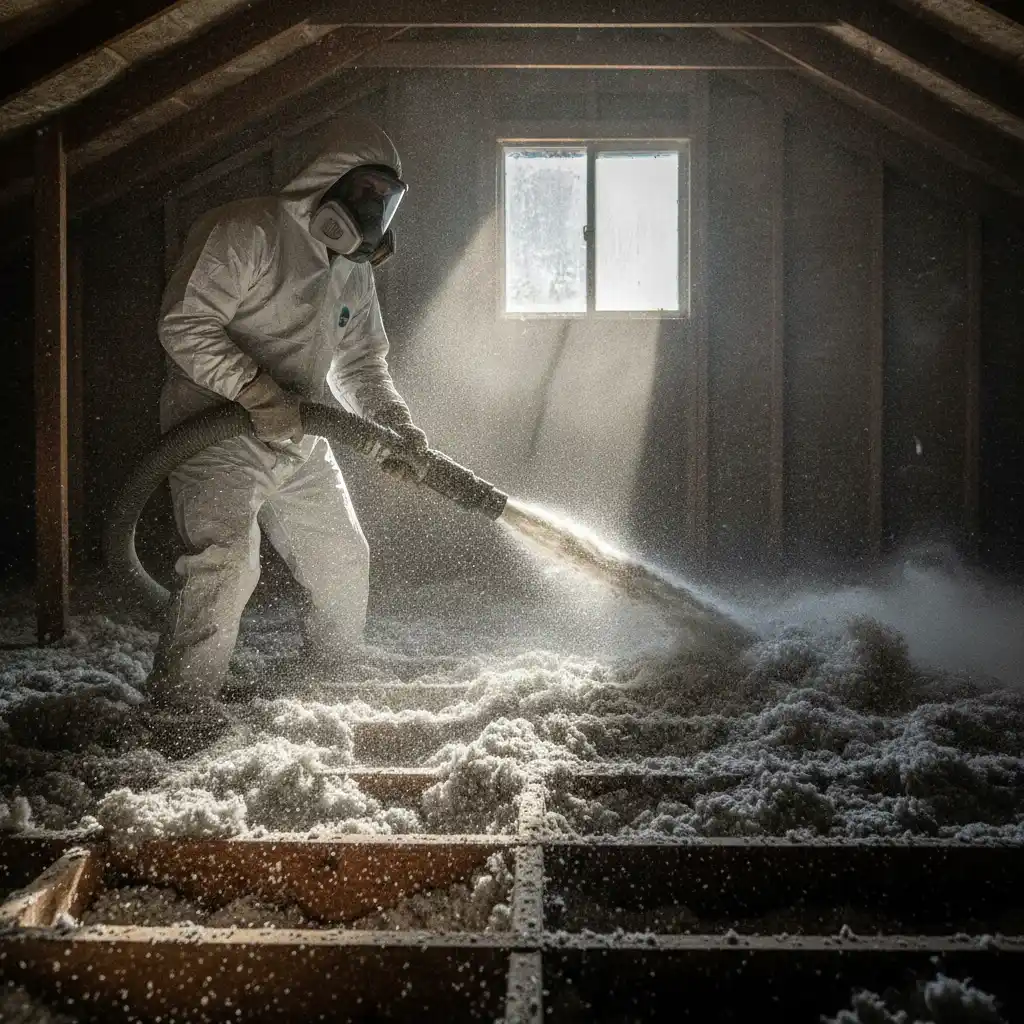
Our team in action — insulation professionals serving North Hollywood
Floor Insulation Methods and Approaches
Fiberglass Batt Insulation
Fiberglass batts are pre-cut panels friction-fitted between floor joists. R-19 batts (approximately 6.25 inches thick) are the standard for North Hollywood’s Climate Zone 9 raised-foundation homes. Best suited for clean, dry crawl spaces with standard 16-inch or 24-inch on-center joist spacing. Cost-effective for straightforward installations with accessible crawl spaces. Batts require vapor retarder facing and wire supports to prevent future sagging — a common failure mode in older North Hollywood installations. View all insulation installation services
Spray Foam Insulation (Open-Cell and Closed-Cell)
Closed-cell spray polyurethane foam delivers R-6 to R-7 per inch and also acts as a vapor barrier — ideal for North Hollywood crawl spaces where moisture intrusion from clay-heavy soils is a documented concern. Applied directly to the underside of the subfloor, it adheres mechanically and will not sag or shift. Open-cell spray foam provides superior air sealing at a lower cost per inch but requires a separate vapor retarder in high-moisture environments. Learn more about spray foam insulation
Blown-In Insulation
Loose-fill cellulose or mineral wool blown into enclosed floor cavities — particularly useful in older North Hollywood homes where floor cavities are narrow or access for batt installation is restricted. Achieves excellent coverage around wiring, pipes, and irregular framing members. Explore blow-in insulation options
Rigid Foam Board
Polyisocyanurate or EPS rigid foam boards are used in slab-on-grade applications or as a thermal break layer beneath floating floors. Particularly useful in North Hollywood condominium conversions and commercial-to-residential adaptive reuse projects near the NoHo Arts District.
Crawl Space Encapsulation
A comprehensive system combining vapor barriers, rigid or spray foam insulation, and conditioned air supply to fully seal the crawl space. The gold standard for high-moisture environments in the North Hollywood river basin corridor. Learn about full crawl space encapsulation
Ready for Floor Insulation? Get Your Free Estimate Today.
NoHo Insulation Pros serves North Hollywood and the surrounding area — we’ll be on-site within 24 hours.
📞 Call (818) 477-1218Floor Insulation Cost in North Hollywood, CA
Understanding floor insulation costs helps homeowners in North Hollywood budget accurately and evaluate quotes with confidence. Pricing varies based on material selection, crawl space accessibility, the square footage of the floor area, and whether existing insulation removal is required.
Typical Price Ranges
- Fiberglass batt insulation (R-19): $1.50 to $3.00 per square foot installed. A typical 1,200 sq ft North Hollywood bungalow crawl space runs approximately $1,800 to $3,600 for material and labor.
- Closed-cell spray foam: $4.00 to $7.00 per square foot installed. The same 1,200 sq ft project ranges from $4,800 to $8,400. Higher upfront cost is often offset by superior moisture resistance and longevity in the local climate.
- Open-cell spray foam: $1.50 to $3.50 per square foot installed — approximately $1,800 to $4,200 for a standard-sized North Hollywood floor area.
- Blown-in cellulose or mineral wool: $2.00 to $4.00 per square foot — $2,400 to $4,800 for a 1,200 sq ft application.
- Crawl space encapsulation (full system): $5,000 to $15,000 depending on crawl space depth, drainage requirements, and vapor barrier thickness.
- Insulation removal: Add $1.00 to $2.50 per square foot for removal of existing degraded material prior to new installation.
North Hollywood-Specific Cost Factors
Los Angeles County labor rates are approximately 20 to 30 percent higher than the national average, reflecting local wage standards. Permit fees through the Los Angeles Department of Building and Safety for insulation work in North Hollywood typically range from $150 to $400 depending on project scope. Some homeowners may qualify for rebates through LADWP’s energy efficiency program, which currently offers up to $500 for qualifying insulation upgrades. Call (818) 477-1218 for a free, itemized estimate specific to your property.
North Hollywood Neighborhoods We Serve
NoHo Arts District
The dense concentration of 1960s and 1970s apartment buildings and recently converted live-work spaces in the NoHo Arts District presents unique floor insulation challenges. Multi-unit buildings require careful acoustic insulation selection to meet LA County noise ordinance requirements. Many structures here sit on shallow slab foundations, making rigid foam board and floating floor systems the primary approach.
Valley Village
Valley Village’s predominantly post-war single-family homes, most built between 1945 and 1960, feature raised foundations with shallow crawl spaces averaging 18 to 30 inches in clearance height. Moisture intrusion from proximity to the Tujunga Wash floodplain makes vapor barrier installation a priority alongside floor insulation here.
Toluca Lake
The larger, older estate homes of Toluca Lake — some dating to the 1920s and 1930s — often have original crawl spaces with no insulation whatsoever. Their generous joist spacing and deeper crawl clearances make them excellent candidates for comprehensive crawl space encapsulation systems.
Lankershim / East North Hollywood
The mixed residential and light industrial corridor along Lankershim Boulevard includes a high density of duplexes and triplex properties with shared floor assemblies. Soundproofing alongside thermal performance is a common dual requirement in this neighborhood.
Laurel Grove
This quiet residential enclave near Whitsett Avenue features homes that were among the most heavily impacted by the 1994 Northridge Earthquake, leaving many with subfloor assemblies that were repaired structurally but never re-insulated to current code standards.
Floor Insulation Maintenance Tips for North Hollywood Homeowners
- Inspect your crawl space annually — ideally every October before the rainy season. Check for moisture, pest activity, and insulation displacement. North Hollywood’s clay soils begin transmitting seasonal moisture in November.
- Keep crawl space vents clear of debris. Southern California’s Santa Ana winds, which typically intensify in October through December, deposit leaves and debris into foundation vents that can restrict airflow and trap moisture.
- Monitor vapor barriers for tears or displacement. Even a small puncture in a crawl space vapor barrier allows significant moisture vapor migration. Inspect after any crawl space access or pest control service.
- Address plumbing leaks immediately. North Hollywood’s older water supply infrastructure means pipe leaks in crawl spaces are not uncommon. Any moisture event should be followed by a same-season insulation inspection.
- Check for rodent activity quarterly. The urban interface environment of North Hollywood creates consistent pressure from roof rats and Norway rats, which damage fiberglass insulation to build nests.
- Reseal crawl space access doors with weatherstripping every two to three years to maintain the thermal and moisture boundary of your insulation system.
- Have insulation professionally assessed every 10 years or after any significant seismic event above magnitude 4.5 that may have shifted subfloor components. Also check your attic insulation during annual inspections
Why Choose NoHo Insulation Pros for Floor Insulation in North Hollywood
NoHo Insulation Pros is a locally focused insulation contractor serving the North Hollywood community and the broader eastern San Fernando Valley. Our team works exclusively in this region, which means we understand the specific building types, soil conditions, and climate patterns that affect insulation performance in ZIP codes 91601, 91602, 91605, and 91606 better than any national franchise or remote contractor.
We are familiar with the permit requirements of the Los Angeles Department of Building and Safety and can guide homeowners through the approval process for qualifying insulation projects. Our installations are designed to meet or exceed California’s Title 24 Energy Code requirements for Climate Zone 9, ensuring your home is code-compliant and positioned to benefit from available LADWP energy efficiency rebate programs.
We offer comprehensive services across the full insulation project lifecycle — from initial assessment and damaged material removal to new installation, crawl space encapsulation, and post-installation documentation. Our integrated approach means you work with a single, accountable team from start to finish rather than coordinating between multiple subcontractors.
We stand behind our work and provide detailed written documentation of all installations. Contact us at (818) 477-1218 to speak directly with a North Hollywood insulation specialist. Learn about our insulation removal services Explore crawl space encapsulation
Frequently Asked Questions About Floor Insulation in North Hollywood, CA
How much does floor insulation cost in North Hollywood?
Floor insulation costs in North Hollywood typically range from $1.50 to $7.00 per square foot installed, depending on material type. A fiberglass batt installation for a standard 1,200 square foot raised-foundation home runs approximately $1,800 to $3,600. Closed-cell spray foam for the same area costs $4,800 to $8,400 but provides superior moisture resistance — an important consideration given North Hollywood’s clay soil conditions. LADWP rebates of up to $500 may be available for qualifying upgrades. Call (818) 477-1218 for a free itemized estimate.
How long does a floor insulation project take in North Hollywood?
Most residential floor insulation projects in North Hollywood are completed in one to three days. A straightforward batt installation in an accessible crawl space can be finished in a single day. Projects requiring insulation removal, vapor barrier installation, and spray foam application typically span two to three days, including a 24-hour cure period for spray foam before adjacent spaces are re-occupied.
Do I need a permit for floor insulation in North Hollywood?
Permit requirements depend on project scope. The Los Angeles Department of Building and Safety typically requires a permit for insulation work associated with structural modifications or crawl space encapsulation systems. Straightforward insulation replacement in kind may not require a permit, but we recommend confirming with LADBS before starting any project. NoHo Insulation Pros can assist with permit applications for projects that require them.
What R-value do I need for floor insulation in North Hollywood?
California’s Title 24 Energy Code for Climate Zone 9 (which includes North Hollywood) requires a minimum of R-19 for floors over unconditioned spaces such as crawl spaces and garages. Homes near heat-intensive areas or with significant moisture challenges may benefit from exceeding this minimum, particularly when using closed-cell spray foam that also functions as a vapor retarder.
My North Hollywood home was built in the 1950s — does it need floor insulation?
Almost certainly. Homes built in North Hollywood before the 1970s were constructed before meaningful energy codes existed in California. If your home has a raised foundation or crawl space and is not experiencing modern comfort levels, there is a strong probability that the floor insulation either never existed or has degraded to near-zero effectiveness. Many homes that appear to have insulation installed actually contain 40-year-old fiberglass batts that have sagged, compressed, or absorbed moisture to the point of being thermally useless.
How do I know if my existing floor insulation is still effective?
Signs of ineffective floor insulation include cold or hot floor surfaces that vary significantly from room air temperature, unusually high LADWP utility bills, musty odors from floor vents, or visible sagging insulation in the crawl space. A professional assessment with moisture metering and thermal imaging provides definitive answers. NoHo Insulation Pros offers free on-site evaluations — call (818) 477-1218 to schedule.
What is crawl space encapsulation and do I need it?
Crawl space encapsulation is a comprehensive sealing system that combines vapor barriers, insulation, and sometimes conditioned air supply to fully isolate the crawl space environment from outdoor conditions. It is the recommended approach for North Hollywood homes in moisture-prone zones, particularly those near the Tujunga Wash corridor or in low-lying sections of Valley Village where seasonal groundwater levels can affect crawl space humidity. Encapsulation extends the life of your floor insulation significantly and eliminates conditions that promote mold and pest activity. Learn more about crawl space encapsulation
Can floor insulation reduce noise as well as temperature?
Yes. Dense-packed cellulose, mineral wool, and closed-cell spray foam all provide meaningful acoustic attenuation in addition to thermal resistance. This is particularly valuable in North Hollywood’s multi-unit residential buildings and homes near Lankershim Boulevard or the Metrolink corridor on Chandler Boulevard, where traffic and transportation noise are persistent concerns. If acoustic performance is a priority, mention this during your assessment so we can recommend materials with the appropriate Sound Transmission Class (STC) ratings.
Get a Free Floor Insulation Estimate in North Hollywood Today
Whether you are dealing with uncomfortable temperature swings between rooms, rising LADWP energy bills, or moisture concerns in your crawl space, NoHo Insulation Pros is ready to help. We serve homeowners and property managers throughout North Hollywood — from the arts district bungalows near Lankershim to the ranch-style homes of Laurel Grove and Valley Village.
Our team provides free, no-obligation on-site assessments with detailed written quotes. We will evaluate your specific floor assembly, identify any existing moisture or pest issues, and recommend the most cost-effective insulation solution calibrated to North Hollywood’s Climate Zone 9 requirements.
Call us now at (818) 477-1218 to speak with a local specialist or to schedule your free assessment. Do not let another San Fernando Valley summer pass with an underperforming floor system. Contact NoHo Insulation Pros today and take the first step toward a more comfortable, energy-efficient home.
Schedule your free floor insulation assessment online