
Mineral Wool Insulation in North Hollywood, CA
Energy-Saving Mineral Wool Insulation for North Hollywood, CA Homes — Licensed & Insured
Get expert mineral wool insulation in North Hollywood, CA. NoHo Insulation Pros offers fire-resistant, acoustic & thermal solutions. Call (818) 477-1218 for a free estimate.
- Licensed & Insured
- Locally Owned & Operated
- Free Inspection & Estimate
Request Your
Free EstimateMineral wool insulation — also known as rock wool or slag wool — is a high-performance thermal and acoustic insulation material manufactured from natural volcanic rock or industrial slag that has been spun into dense, fire-resistant fibers. For homeowners and business owners in North Hollywood, CA, this material offers a powerful solution to the unique thermal extremes, fire risks, and noise challenges that define life in the eastern San Fernando Valley.
North Hollywood’s climate swings from scorching summer highs well above 100°F in neighborhoods like Lankershim and the Arts District to cool, damp winter nights — a range that puts enormous strain on conventional insulation materials. Mineral wool’s superior R-value per inch, natural moisture resistance, and Class A fire rating make it ideally suited for this environment.
At NoHo Insulation Pros, our team specializes in mineral wool insulation installation throughout North Hollywood. From bungalows built in the 1940s to modern mixed-use developments along the NoHo Arts District corridor, we deliver precision installation tailored to every structure. Call us today at (818) 477-1218 to schedule your free assessment.
Understanding Mineral Wool Insulation
Mineral wool insulation has been used in construction since the late 19th century, with commercial production beginning in earnest in the United States by the 1930s. Unlike fiberglass — which is spun from molten glass — mineral wool is produced by melting basaltic rock, iron ore slag, or a combination of both at temperatures exceeding 2,900°F and then spinning or blowing the molten material into fine, interlocking fibers. The result is a dense, mat-like product that can be manufactured as batts, boards, or loose-fill material.
Mineral wool achieves R-values typically ranging from R-3.0 to R-3.3 per inch in batt form, and it maintains that performance across a wide temperature spectrum — a critical advantage in a city like North Hollywood where attic temperatures can realistically reach 150°F during a July heat event. Fiberglass, by comparison, can lose meaningful performance when temperatures climb dramatically.
Beyond thermal performance, mineral wool is naturally hydrophobic. The fibers repel liquid water rather than absorbing it, meaning that even in the event of a minor roof leak or elevated interior humidity — both common in older North Hollywood construction — the insulation will not become waterlogged, compress, or serve as a medium for mold growth.
Acoustically, mineral wool’s dense fiber matrix absorbs sound waves at a significantly higher rate than fiberglass. This property is especially valuable in North Hollywood, a city bisected by the Metro B Line (Red Line) tracks, the 170 Freeway, and one of the busiest entertainment industry corridors in Los Angeles County. Residents living within blocks of Lankershim Boulevard or near the Whitnall Highway commercial strip report measurable reductions in interior noise levels after mineral wool installation.
Mineral wool is also non-combustible, with a melting point above 1,800°F. It will not feed flames, and it does not produce toxic smoke when exposed to fire — a feature that carries particular importance in North Hollywood, a community that has experienced repeated brush fire encroachment from the Verdugo Hills to the north and the Santa Monica Mountains to the southwest.
North Hollywood’s diverse building stock — ranging from post-war wood-frame bungalows in the Magnolia Park area to mid-century apartment complexes along Camarillo Street and new concrete tilt-up commercial construction near the NOHO West development — means that mineral wool must be selected and installed with careful attention to framing systems, cavity dimensions, and vapor management strategies appropriate to each building type.
Why Mineral Wool Insulation Is Needed in North Hollywood, CA
Extreme San Fernando Valley Heat
The National Weather Service station at nearby Burbank Airport has recorded temperatures in excess of 113°F during prolonged heat events, most recently during the catastrophic September 2022 heat dome that pushed Los Angeles County into a state of emergency. In North Hollywood specifically, the urban heat island effect — driven by the density of impervious surfaces along Lankershim Boulevard, Tujunga Avenue, and the commercial corridors near the 170/101 interchange — adds an additional 5°F to 8°F of ambient heat compared to coastal neighborhoods. Attic temperatures in uninsulated or under-insulated homes in the Toluca Lake-adjacent portions of North Hollywood routinely exceed 140°F in July and August, forcing HVAC systems to work continuously and driving electricity bills well above $400 per month for average-sized homes.
Mineral wool’s resistance to thermal degradation at these elevated temperatures makes it uniquely suited to attic applications in this zone. Standard kraft-faced fiberglass batts can experience adhesive failure and vapor barrier degradation at sustained temperatures above 120°F — a threshold regularly breached in North Hollywood attics.
Fire Risk and WUI Proximity
North Hollywood sits at the edge of Los Angeles County’s Wildland-Urban Interface (WUI). The Verdugo Mountains to the northeast and the hillside neighborhoods bordering Sun Valley and Pacoima to the north create defensible space challenges that extend into the flatlands. The 2019 Saddleridge Fire, which burned more than 8,800 acres in the Sylmar-Granada Hills area just 10 miles to the northwest, demonstrated how rapidly fire conditions can develop across the valley floor. Mineral wool’s non-combustible rating under ASTM E136 standards provides an additional layer of passive fire resistance in wall cavities and attic spaces, slowing potential fire spread and providing valuable evacuation time.
Aging Construction and Thermal Envelope Failures
Much of North Hollywood’s residential stock was constructed between 1945 and 1975, during an era when California building codes imposed minimal insulation requirements. Homes in neighborhoods like Otsego Park, Laurel Grove, and the blocks east of Lankershim near the NoHo Arts District frequently contain original fiberglass batts that have settled, moisture-damaged, or simply degraded over 50 to 70 years of service. Settled insulation can lose 20% to 40% of its original R-value, leaving thermal envelopes dramatically undersized for current Title 24 energy code expectations.
Noise Pollution from Infrastructure
The Metro B Line subway runs beneath Lankershim Boulevard, and surface-level train vibration affects buildings within approximately 500 feet of the corridor. The 170 Freeway generates continuous broadband noise measurable at 65 to 72 decibels at residential property lines in adjacent neighborhoods. Mineral wool’s Sound Transmission Class (STC) improvement of 5 to 10 points over fiberglass in typical wall assemblies makes it the preferred choice for residents seeking meaningful noise reduction in these high-exposure zones.
Moisture and Crawl Space Conditions
North Hollywood’s older housing stock — particularly homes in the Weddington Street corridor and around Colfax Meadows — frequently features raised wood-frame construction over unencapsulated crawl spaces. Winter rainfall, averaging approximately 14 inches annually in the valley floor, combined with clay-heavy Ramona series soils that drain poorly, creates chronic crawl space moisture conditions that destroy conventional fiberglass insulation within five to eight years. Mineral wool’s hydrophobic properties dramatically extend service life in these conditions.
Signs You Need Mineral Wool Insulation in North Hollywood
Energy and Comfort Warning Signs
- Monthly electricity bills exceeding $300 during summer months in a home under 2,000 square feet
- Interior temperatures that remain above 80°F even with the air conditioner running continuously
- Noticeable hot or cold spots in specific rooms, particularly in second-floor bedrooms directly below the roofline
- HVAC system cycling more than three times per hour during peak afternoon heat
Physical and Structural Warning Signs
- Visible insulation settling or compression when viewed through an attic access hatch
- Discolored, wet, or crumbling batts — particularly common in crawl spaces beneath homes in the Colfax Meadows and Weddington areas
- Drafts detectable along wall plates, electrical outlets, or window frames during windy Santa Ana conditions
- Moisture staining on interior ceiling drywall near exterior wall junctions
Acoustic Warning Signs
- Clearly audible street noise, Metro train sounds, or freeway rumble inside closed rooms
- Sound transmission between interior rooms that makes normal conversation audible through walls
Urgency Indicators
If your home was built before 1980 and has never had insulation replaced, or if you have experienced any roof leaks or plumbing failures in the last decade, schedule an inspection immediately. Degraded insulation in these scenarios frequently harbors mold colonies that pose direct health risks.
Our Mineral Wool Insulation Process in North Hollywood
Comprehensive On-Site Assessment (1–2 Hours)
Our technician visits your North Hollywood property to conduct a complete thermal envelope inspection. We use infrared thermography to identify cold bridges, settled insulation zones, and air leakage pathways that are invisible to the naked eye. We document existing R-values, check for moisture intrusion in crawl spaces and attic decking, and evaluate vapor management conditions appropriate to North Hollywood’s Climate Zone 9 designation under California Title 24.
Removal of Degraded Existing Insulation (Half Day to Full Day)
Where existing insulation has settled, moisture-damaged, or pest-contaminated material is present, we remove it using HEPA-equipped vacuum systems and commercial air-washing equipment. This step is particularly common in attics of pre-1975 homes in the Lankershim Boulevard corridor and crawl spaces in the Otsego Park neighborhood. All removed material is bagged and disposed of in compliance with Los Angeles County waste regulations.
Air Sealing and Preparatory Work (2–4 Hours)
Before any new mineral wool is installed, we seal all penetrations, top plates, recessed light housings, and HVAC chases with fire-rated foam or caulk. Air sealing can improve total building energy performance by 15% to 25% independently of insulation R-value gains — a step that many contractors skip but that we treat as non-negotiable in North Hollywood’s high-temperature climate.
Mineral Wool Installation (Half Day to Full Day Depending on Scope)
We cut and friction-fit mineral wool batts to fill stud and joist bays without compression, which would reduce effective R-value. For irregularly framed older homes common in the Magnolia Park and Laurel Grove areas, we use cut-and-cobble techniques to ensure complete coverage without gaps. All installations target current California Title 24 minimums or exceed them where project specifications allow.
Vapor Management Installation (1–2 Hours)
Depending on assembly type and location within the structure, we install appropriate vapor retarders or barriers. In North Hollywood’s Climate Zone 9, vapor management strategies differ significantly from coastal zones, and we apply zone-specific detailing to prevent interstitial condensation.
Quality Inspection and Thermal Verification (1 Hour)
Upon completion, we conduct a post-installation infrared scan to confirm uniform coverage and identify any missed areas. We document R-values achieved and provide a written completion report that can be used for Title 24 compliance documentation or utility rebate applications through Southern California Edison or SoCalGas.
Site Cleanup and Client Walkthrough (30–45 Minutes)
We restore all access panels, remove all materials and equipment, and walk you through the completed installation with photographic documentation of before and after conditions.
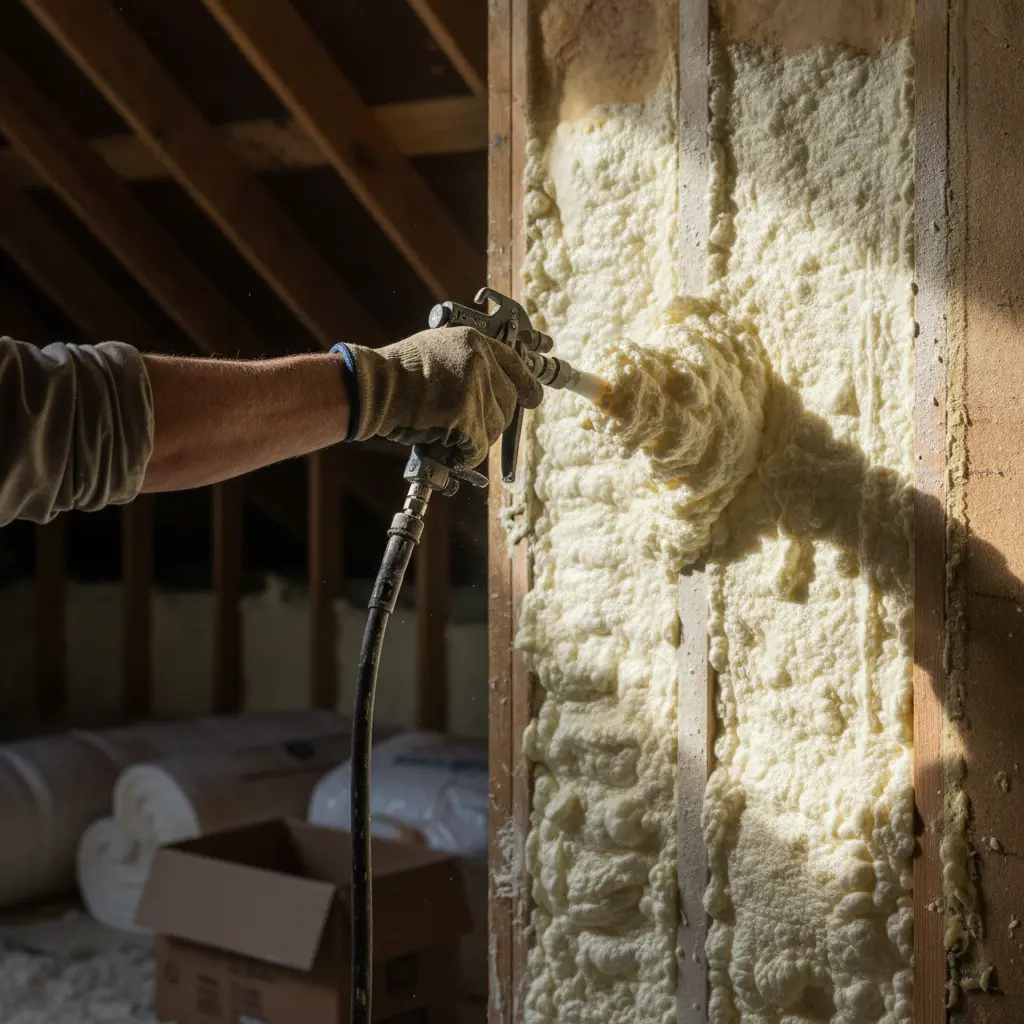
Our team in action — insulation professionals serving North Hollywood
Mineral Wool Insulation Methods and Approaches
Batt and Roll Installation
The most common method for new construction and renovation projects, mineral wool batts are precision-cut and friction-fit into standard 16-inch and 24-inch stud bays and floor joist bays. This method is ideal for exposed framing in attic knee walls, exterior walls during remodel work, and floor assemblies above unencapsulated crawl spaces — all highly prevalent conditions in North Hollywood’s 1950s and 1960s housing stock. Typical R-values achieved range from R-15 in 2×4 walls to R-23 in 2×6 framing.
Continuous Insulation Boards
Rigid mineral wool boards applied to exterior wall surfaces or roof assemblies eliminate thermal bridging through framing members, which can account for 15% to 25% of total wall heat loss in wood-frame construction. This method is particularly effective on the south- and west-facing facades of commercial and mixed-use buildings in the NoHo Arts District and NOHO West development zones, where solar gain is greatest during afternoon hours.
Mineral Wool Loose-Fill (Blow-In)
For existing finished walls and hard-to-access attic areas, mineral wool loose-fill can be dense-packed through small-diameter access holes. This method is frequently used in North Hollywood’s intact Craftsman bungalows where interior wall demolition is not feasible or desirable. learn more about blow-in insulation services
Combined Mineral Wool and Spray Foam Systems
In some high-performance applications — particularly in commercial buildings or residential structures targeting LEED or California Green Building Standards Code compliance — we combine a closed-cell spray foam air barrier at the framing line with mineral wool fill insulation. This hybrid approach maximizes both air control and thermal resistance. explore our spray foam insulation services
Ready for Mineral Wool Insulation? Get Your Free Estimate Today.
NoHo Insulation Pros serves North Hollywood and the surrounding area — we’ll be on-site within 24 hours.
📞 Call (818) 477-1218Mineral Wool Insulation Cost in North Hollywood
Understanding realistic cost ranges helps North Hollywood property owners budget appropriately and evaluate competitive bids. The following figures reflect current material and labor costs in the Los Angeles metro market as of 2024.
Typical Price Ranges
- Attic mineral wool insulation (batt installation): $1.50–$2.50 per square foot of attic floor area, with most North Hollywood residential attic projects falling between $1,800 and $4,500 total.
- Exterior wall mineral wool batt installation (during remodel): $2.00–$3.50 per square foot of wall area, or approximately $3,500–$7,000 for a typical 1,500-square-foot North Hollywood bungalow.
- Crawl space mineral wool floor insulation: $2.50–$4.00 per square foot, with complete crawl space projects typically ranging from $2,500 to $6,000 depending on access conditions and moisture remediation needs. view crawl space insulation details
- Rigid mineral wool board (exterior continuous insulation): $3.00–$5.50 per square foot installed, typically a commercial or major renovation application.
Key Cost Factors in North Hollywood
- Existing insulation removal: Adds $0.50–$1.25 per square foot — common in pre-1980 homes. learn about our insulation removal services
- Attic access difficulty: Tight attic clearances in low-pitch roofs common in 1950s ranch-style North Hollywood homes can increase labor time by 25%–40%.
- Pest damage remediation: Rodent activity — prevalent in properties near the Tujunga Wash greenway — may require additional sanitation steps before installation.
- Utility rebates: Southern California Edison’s Energy Upgrade California program offers rebates up to $400 for qualifying insulation upgrades, effectively reducing net project cost.
Contact us at (818) 477-1218 for a no-obligation itemized estimate specific to your property.
North Hollywood Neighborhoods We Serve
NoHo Arts District
The walkable corridor along Lankershim Boulevard between Magnolia Avenue and Weddington Street features a dense mix of pre-war bungalows, converted commercial buildings, and new mixed-use construction. Older structures here often have original 1940s insulation or none at all, while newer construction targets Title 24 2022 compliance. We service both contexts with mineral wool solutions scaled to each building type.
Lankershim / Otsego Park
This predominantly residential grid of post-war tract homes built between 1948 and 1965 presents classic under-insulation challenges: uninsulated exterior walls, minimal attic coverage, and aging crawl space conditions. These properties see some of the highest interior temperature gains during summer heat events due to their low-slope roof designs.
Laurel Grove
Bordering Burbank to the north, Laurel Grove contains a mix of 1950s ranch homes and newer infill construction. Proximity to the Burbank Airport flight corridor creates significant noise exposure, making mineral wool’s acoustic performance properties especially valuable to residents here.
Magnolia Park (North Hollywood Portion)
This neighborhood retains a high density of pre-war Craftsman and Spanish Colonial Revival homes with original plaster walls and minimal wall cavity insulation. Blow-in mineral wool is frequently the preferred approach here to preserve interior finishes. explore attic insulation options
Weddington / Colfax Meadows
Located adjacent to the Tujunga Wash, these neighborhoods experience elevated ground moisture and occasional minor flood conditions during heavy rainfall years. Crawl space moisture management combined with mineral wool floor insulation is the standard recommendation for properties in this zone. learn about crawl space encapsulation
Mineral Wool Insulation Maintenance Tips for North Hollywood Homeowners
- Inspect attic insulation annually before summer: Check in May or early June, before temperatures peak, for signs of settling, pest activity, or moisture intrusion near roof penetrations.
- Monitor crawl space moisture after winter rains: Following rainfall events greater than 1 inch — common between December and March in North Hollywood — inspect crawl space vents and vapor barriers for water pooling on the ground surface.
- Seal new attic penetrations promptly: HVAC modifications, new recessed lighting, or cable installations that penetrate insulated assemblies should be resealed with fire-rated foam within 30 days to prevent air bypass.
- Check for pest entry points along foundation sill plates: Rodents entering from the Tujunga Wash greenway commonly access crawl spaces and wall cavities through gaps at the foundation perimeter. Seal all gaps larger than one-quarter inch.
- Verify attic ventilation remains unobstructed: Mineral wool performs optimally when soffit vents and ridge vents are clear. Check for wasp nests or debris accumulation each spring.
- Avoid compressing mineral wool batts with stored items: Items stored in attic spaces should not rest directly on insulation batts. Even partial compression reduces effective R-value measurably.
- Schedule a professional thermal scan every 10 years: Infrared inspection identifies performance degradation before it becomes a significant energy cost issue.
Why Choose NoHo Insulation Pros for Mineral Wool Insulation in North Hollywood
NoHo Insulation Pros is a locally operated insulation contractor with deep roots in the North Hollywood community. Our technicians work exclusively in the eastern San Fernando Valley, which means we understand the specific construction patterns, climate conditions, and code requirements that affect properties in this area — knowledge that contractors based in distant parts of the metro region simply do not have.
We handle the complete range of insulation services your property may need: professional insulation installation, attic insulation, insulation removal and replacement, spray foam insulation, and crawl space encapsulation. This full-service capability means we can address every aspect of your building’s thermal envelope in a single engagement rather than coordinating multiple contractors.
We use only manufacturer-certified mineral wool products with published performance data, and every installation is completed to California Title 24 standards. Our project documentation supports Southern California Edison and SoCalGas rebate applications, and we’re always available by phone at (818) 477-1218 to answer your questions before, during, and after your project.
When you search for mineral wool insulation near me in North Hollywood, you deserve a contractor who knows your neighborhood by name — not just by zip code. That’s what we deliver.
Frequently Asked Questions: Mineral Wool Insulation in North Hollywood
How much does mineral wool insulation cost in North Hollywood?
Costs vary by application and scope. Attic batt installation typically ranges from $1,800 to $4,500 for a standard North Hollywood single-family home. Wall insulation during remodel work runs $3,500 to $7,000 for a typical 1,500-square-foot bungalow. Crawl space floor insulation projects generally fall between $2,500 and $6,000. Southern California Edison rebates can offset a portion of these costs for qualifying projects. Call us at (818) 477-1218 for a precise estimate.
Is mineral wool better than fiberglass for North Hollywood’s climate?
For most North Hollywood applications, yes. Mineral wool maintains its R-value at the extreme attic temperatures common here — regularly above 140°F in summer — whereas fiberglass can experience performance reduction under sustained high heat. Mineral wool also offers superior fire resistance and acoustic performance, both important priorities given North Hollywood’s wildfire proximity and urban noise environment.
How long does mineral wool insulation installation take?
A typical attic insulation project in a 1,500–2,000 square foot North Hollywood home takes one full day, including any existing insulation removal. Crawl space projects typically require one to two days depending on access conditions. Whole-house projects spanning attic, walls, and crawl space may take two to three days total.
Can mineral wool be installed in walls without opening the drywall?
In many cases, yes. We can dense-pack mineral wool loose-fill into existing wall cavities through small access holes in either the exterior siding or interior drywall — a common approach in Craftsman homes in the Magnolia Park area of North Hollywood where preserving original wall finishes is a priority. We assess each home individually to determine the least invasive approach.
Does mineral wool insulation help with noise from the 170 Freeway or Metro trains?
Yes, meaningfully so. Mineral wool provides an STC improvement of approximately 5 to 10 points over fiberglass in equivalent wall assemblies. For homes within 1,000 feet of the 170 Freeway or within several blocks of the Metro B Line corridor on Lankershim Boulevard, this translates to a perceptible reduction in interior noise levels — particularly for mid-frequency traffic and rail sounds.
Is mineral wool safe to handle and live with after installation?
Modern mineral wool products are classified as non-carcinogenic by major health authorities including the International Agency for Research on Cancer (IARC). The fibers used in current building insulation products are specifically engineered to be biopersistent at safe levels. During installation our technicians wear appropriate respiratory protection, and once installed in walls or attic spaces, mineral wool poses no exposure risk to building occupants.
Will new insulation help me qualify for California energy rebates?
Potentially, yes. Southern California Edison’s Energy Upgrade California program and SoCalGas rebate programs offer incentives for insulation upgrades that meet specified minimum R-value thresholds. NoHo Insulation Pros provides documentation of R-values achieved and installation specifications in a format compatible with rebate application requirements. We recommend contacting your utility provider before installation to confirm current rebate availability.
What is the lifespan of mineral wool insulation in a North Hollywood home?
When properly installed and maintained in a dry, protected environment, mineral wool insulation can last 50 years or more without significant performance degradation. Its inorganic composition means it does not rot, support mold growth, or attract insects — a significant longevity advantage over organic or cellulose-based insulation materials in North Hollywood’s variable moisture conditions.
Get Your Free Mineral Wool Insulation Estimate in North Hollywood Today
If you’re ready to reduce energy bills, improve interior comfort, lower noise levels, and increase fire resistance in your North Hollywood home or commercial property, NoHo Insulation Pros is ready to help. Our team serves neighborhoods across North Hollywood — from the NoHo Arts District and Otsego Park to Laurel Grove and Colfax Meadows — with mineral wool insulation solutions sized and specified for each unique building.
We offer free, no-obligation on-site assessments with infrared thermal imaging so you can see exactly what your building’s insulation needs before committing to any work.
Call us now at (818) 477-1218 to schedule your assessment or to get answers to any questions about mineral wool insulation in North Hollywood. Our team is available Monday through Saturday and happy to discuss your project in detail.
Contact NoHo Insulation Pros online to request your free estimate